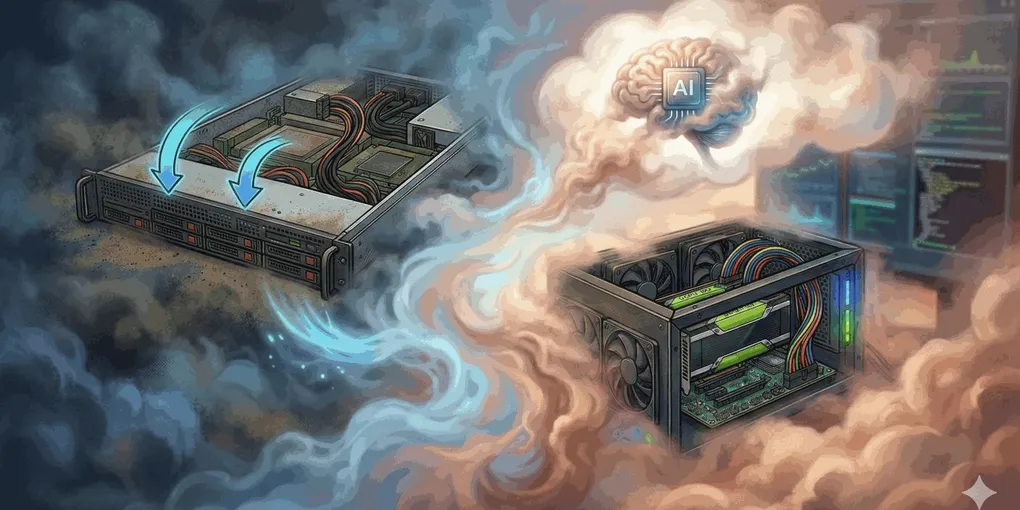
TL;DR
GPU prices are climbing toward $5,000 for consumer cards. But you can repurpose enterprise AI accelerators—specifically the Tesla V100 SXM2—into your workstation for under $400. This guide walks through hardware selection, thermal management, BIOS configuration, and software setup to run local LLMs on data center hardware.
The Problem
RAM and GPU prices continue climbing. Predictions put the RTX 5090 at $5,000. The driver? AI investment. As demand surges, buying power shrinks for everyone except those with billion-dollar budgets.
But there’s an alternative: secondhand data center AI accelerators.
Why the Tesla V100 SXM2?
The Tesla V100 16GB SXM2 is typically the “brain” inside DGX servers. Key specs:
| Spec | Value |
|---|---|
| Memory | 16 GB HBM2 |
| Tensor Cores | 640 |
| Boost Clock | ~1,600 MHz |
| TDP | 250 W |
| Interface | SXM2 (not PCIe) |
The 32GB version exists but costs 4x more. For most local LLM workloads, 16GB is the sweet spot for price-to-performance.
What You’ll Need
Hardware
| Component | Purpose | Approximate Cost |
|---|---|---|
| Tesla V100 16GB SXM2 | The AI accelerator | $150-250 |
| SXM2 to PCIe Adapter | Converts interface + cooling | $100-150 |
| Thermal Pads (1.5mm + 5mm) | VRM/HBM contact | $10-20 |
| Thermal Paste | GPU die contact | $10 |
| Workstation with 800W+ PSU | Power delivery | (existing) |
| PCIe 6+2 pin cables | GPU power | $5-10 |
Software
- LM Studio - LLM inference (works)
- Ollama - Alternative inference (doesn’t work with V100 SXM2)
- CUDA 11 Drivers - Older drivers required for detection
- MSI Afterburner - Power limit tuning
- HWiNFO - Hardware monitoring
Step 1: Prepare the Accelerator
Clean the Thermal Paste
Used accelerators arrive with residual thermal paste. Clean carefully:
- Apply isopropyl alcohol to tissue paper
- Gently wipe the GPU die and VRM areas
- Use a plastic tool (like an ice cream stick) to avoid damaging components
- The SXM2 connector on the rear is extremely delicate—avoid contact
Apply Thermal Pads
The V100 has multiple contact points requiring different pad thicknesses:
| Component | Pad Thickness | Layers |
|---|---|---|
| GPU Die | Thermal paste only | N/A |
| VRM Chips | 1.5mm | 3 layers |
| HBM Stacks | 5mm | 2 layers |
| End Caps | 1.5mm + 5mm stacked | Varies |
Measure clearance by doing a test fit before finalizing. The copper heat sink must make full contact with all thermal pads.
Apply Thermal Paste
Use the “smiley face” method on the bare die—it provides ~85% coverage consistently. Remove any protective plastic film from the copper heat sink.
Step 2: Mount to the Adapter
SXM2 Connection
The SXM2 connector has extremely fine pins. Handle with care:
- Align the accelerator over the adapter standoffs
- Only one SXM2 connector is needed (the other is for NVLink)
- The fitment is foolproof—standoffs prevent incorrect installation
- Secure in a crisscross pattern: middle four screws first, then outer four
Install the Shroud
The adapter includes a 3D-printed shroud that creates a funnel effect for airflow:
- The centrifugal fan forces air through the copper heat sink
- Hot air exhausts through rear vents
- The shroud may have slight fitment issues—work around them
Step 3: Workstation Requirements
Minimum Specifications
| Requirement | Why |
|---|---|
| AVX2 CPU Support | Required for LLM inference |
| 800W+ PSU | 250W TDP + system overhead |
| PCIe 3.0 x16 slot | Bandwidth for accelerator |
| Two 6+2 pin connectors | Power delivery |
Warning: Older workstations without AVX2 (like HP Z620 with Sandy/Ivy Bridge) won’t detect the accelerator or run LLMs. The HP Z8 G4 with Skylake/Cascade Lake Xeons works perfectly.
BIOS Settings (Critical)
These settings must be configured or the card won’t detect:
| Setting | Value | Why |
|---|---|---|
| PCIe MMIO | Fixed/Manual | Enables memory-mapped I/O |
| Above 4G Decoding | Enabled | Required for 16GB VRAM addressing |
| PCIe Slot Speed | Manual (max speed) | Auto often fails |
| Secure Boot | Disabled | Allows unsigned drivers |
| Performance Mode | Maximum | Handles transient power draws |
Check the BIOS event log for hardware faults—it helped diagnose a dead CMOS battery during setup.
Step 4: Driver Installation
CUDA 11 is Required
The latest CUDA drivers do not work with the V100 SXM2 on consumer setups. Install CUDA 11 first:
# Download CUDA 11.x from NVIDIA archive# The specific version tested: 11.8You can upgrade CUDA later, but start with 11.x for initial detection.
Verification Tools
- HWiNFO - Confirms PCIe slot speed and basic detection
- MSI Afterburner - Shows driver status and allows power limit adjustment
- Device Manager - Should show “Tesla V100”
Power Tuning
In MSI Afterburner, reduce the power limit slightly to lower thermals. The stock blower fan is noisy and the copper heat sink has limits.
Step 5: Software Configuration
LM Studio Setup
LM Studio works excellently with the V100:
- Download and install LM Studio
- Enable Developer Mode in settings
- Navigate to Developer settings
- Verify V100 detection (shows as CUDA device)
- Disable any secondary display GPUs from inference
- Check temperature baseline (mine was 66°C idle)
CUDA Runtime
In LM Studio’s Developer settings, update the CUDA runtime. Even if marked “non-compatible,” it works after installation.
Without this step, inference fails silently.
Model Selection
The 16GB VRAM limits model size:
| Model | Parameters | VRAM Usage | Works? |
|---|---|---|---|
| Gemma 3 | 4B | ~3-4 GB | ✓ |
| Qwen 2.5 | 4B | ~3-4 GB | ✓ |
| GPT-OSS | 20B | ~15-16 GB | ✓ (tight) |
Step 6: Testing
First Run
With everything configured:
- Load a model in LM Studio
- Send a test prompt: “What are your abilities?”
- Monitor temperatures in MSI Afterburner
Observed Performance
| Metric | Value |
|---|---|
| Idle Temperature | 66°C |
| Load Temperature | 82-87°C |
| Power Draw (inference) | ~180W |
| Max Power Draw | 250W (not reached in testing) |
What Doesn’t Work
Ollama fails with CUDA errors. It doesn’t expose runtime settings like LM Studio, making it incompatible with this setup.
Trade-offs and Limitations
Pros
- Cost: ~$400 total vs $5,000 for RTX 5090
- VRAM: 16GB HBM2 (faster than GDDR6)
- Tensor Cores: 640 cores optimized for AI
- No consumer GPU shortage: Enterprise hardware is readily available
Cons
- Noise: The blower fan is server-grade loud
- Heat: 87°C under load—needs ventilation
- No display output: Requires a secondary GPU for display
- Ollama incompatibility: Limited to LM Studio
- Delicate installation: SXM2 pins are fragile
- BIOS requirements: Not all systems support above 4G decoding
Safety Considerations
Power Delivery
The adapter converts EPS power to PCIe power. Verify:
- Pin outs match specification
- Cables are rated for 18A per line
- PSU has sufficient headroom
Thermal Management
Without proper thermal pad contact:
- VRM chips will overheat
- HBM memory will throttle
- Performance degrades rapidly
Open WebUI / Open Claw Warning
The transcript mentions “Open Claw” (or similar)—software that grants AI agents full system access to your computer. This is a security nightmare. If experimenting:
- Run in an isolated VM
- No network access
- No real data
Lessons Learned
- Test before final assembly: The Z620 wasted time due to AVX2 incompatibility
- Thermal pad layering matters: Multiple layers ensure contact across uneven surfaces
- BIOS settings are critical: Without above 4G decoding, the card won’t detect
- CUDA 11 first: Newer drivers fail; start old, upgrade later
- LM Studio over Ollama: Runtime configurability makes the difference
Complete Parts List
Tesla V100 16GB SXM2 - Local marketplace ($150-250)SXM2 to PCIe Adapter w/ Fan - Online retailers ($100-150)Thermal Grizzly Cryonaut - Amazon ($10)Thermal Pads 1.5mm - Amazon ($5)Thermal Pads 5mm - Amazon ($5)6-pin to 8-pin Adapters - Online ($5-10)HP Z8 G4 Workstation - eBay/Refurbished ($300-500)Total: ~$600-900 (assuming workstation purchase)
Further Reading
Running local LLMs doesn’t require a $5,000 GPU. With some DIY effort and enterprise cast-offs, you can have a capable AI workstation for a fraction of the cost. Just keep a fire extinguisher handy during first boot.