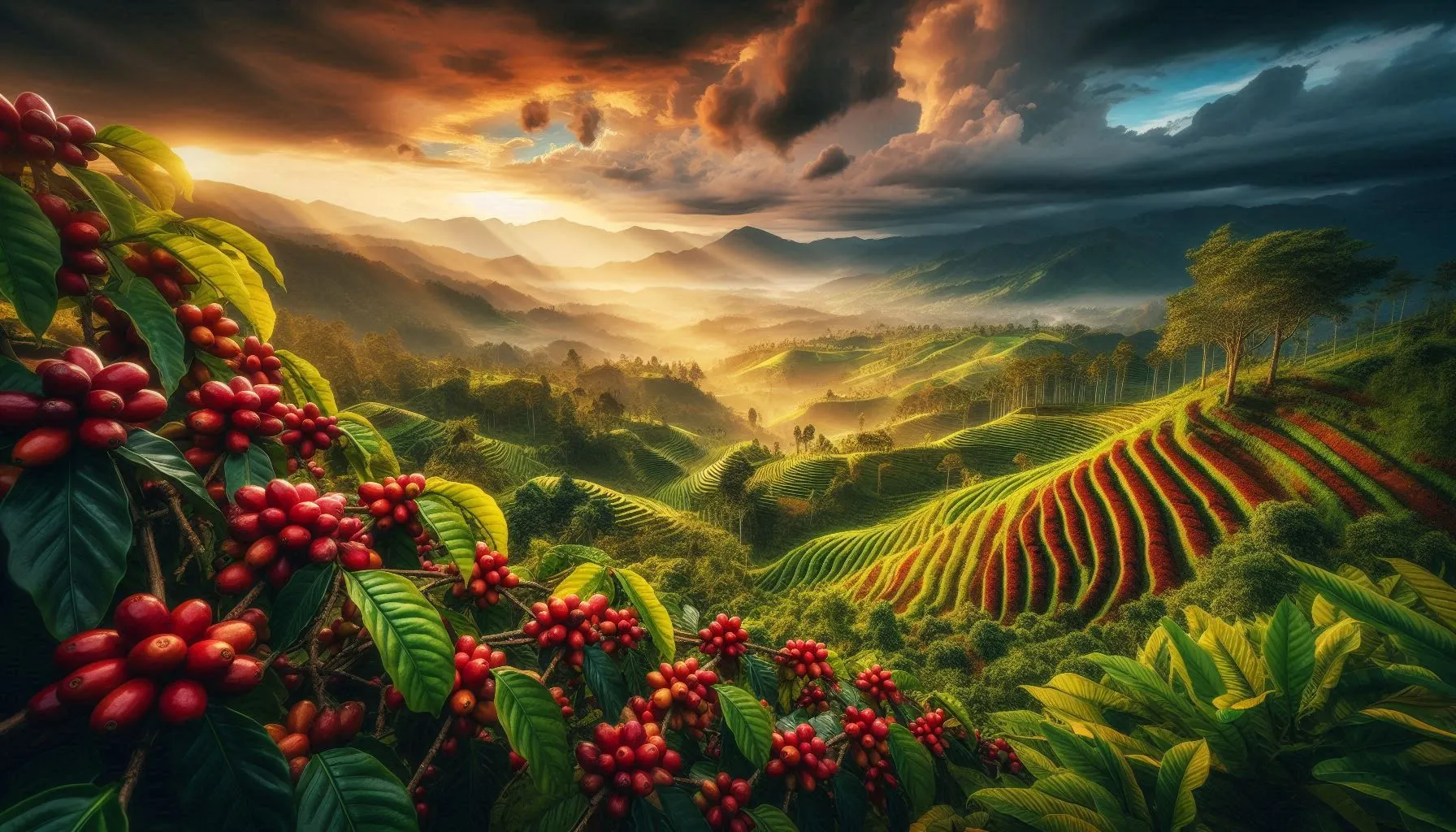
If your morning coffee feels flat, your chocolate bar less rich, or your rice lacks that familiar aroma — you’re not imagining things. The climate is rewriting the flavour of some of the world’s most beloved crops, and Indonesia, Southeast Asia’s largest agricultural producer, is on the front lines.
A recent CNA Insider documentary followed farmers, sommeliers, and chocolatiers across Java and Sulawesi to document what’s happening on the ground. Here’s what they found.
Coffee: Bitter Beans at Higher Altitudes
Indonesia is the world’s fourth-largest coffee producer and Asia’s fastest-growing coffee market. The country has over 460,000 cafes — the most in the world. But behind the specialty pour-overs and third-wave roasters, trouble is brewing.
The altitude problem. Arabica beans grow ideally between 18-22°C. Decades ago, arabica could be planted at 650-700 metres above sea level. Then it shifted to 750 metres. Now, even at 1,200 metres, conditions are barely favourable. Rising temperatures are steadily pushing viable growing zones higher.
Taste shifts. Heat and erratic rainfall alter the beans’ chemistry at the molecular level. Kalosi coffee from Sulawesi, once known for its clean, citrusy character, has developed ripe fruit notes due to a lack of sunshine. In cupping sessions, professionals are noticing more bitterness, less acidity, and reduced complexity.
The pest explosion. Warmer weather encourages the coffee berry borer beetle, devastating arabica trees. Combined with delayed harvests — traditionally starting in May, now pushed to June or July — farmers are seeing yields plummet.
One West Java farmer with 8,000 arabica trees expects just eight tonnes this season from a normal yield of 25 tonnes. Excessive rain causes flowers to drop, young shoots to rot, and fungal infections to spread through the bark.
If a plantation does not have enough protection from shade trees, the taste will be flat. The trees will lack nutrition too.
— Uden Banu, coffee quality inspector, West Java
Price pressure. In early 2025, arabica futures in New York hit all-time highs. Fewer young people want to take up farming, compounding the supply crunch. Some projections suggest coffee production could drop by 50% in the coming decades.
Chocolate: Less Chocolatey Chocolate
Cocoa has been called “black gold” and “food of the gods.” But the beans behind every chocolate bar are under siege.
Temperature and fat content. Cocoa plants thrive between 18-32°C. In parts of West Africa, the world’s largest cocoa-growing region, climate change has added roughly 40 additional days per year above this threshold. The biochemical impact is direct: high temperatures degrade the fat content of cocoa beans. Normally around 50-55% fat, reduced fat means less cocoa butter — and that’s what gives chocolate its flavour, smoothness, and melt.
The result? Chocolate becomes less chocolatey.
Pests adapting faster than plants. The cocoa pod borer, a moth that feeds on pulp and beans inside pods, is spreading faster as temperatures rise. Insects have short life cycles, so they adapt to climate shifts much faster than the plants they prey on.
Indonesia’s cocoa output tells the story: from 530,000 tonnes two decades ago down to 200,000 tonnes today. The country dropped from the world’s third-largest producer to seventh.
Pollination failure. Cocoa trees produce thousands of flowers, but they can’t self-pollinate — they need wind and insects to carry pollen between different trees. Continuous rain suppresses insect activity, and farmers are seeing fewer pods as a result.
If you ask me about the weather, then I can tell you it’s total chaos.
— Asep Heryan Priatna, cocoa farmer, West Java
Chocolate prices climbed about 15% in 2025. Compared to a decade ago, the price increase is fourfold. Premium chocolate makers like Pipiltin Cocoa, who source beans from seven Indonesian regions, are finding it increasingly difficult to secure consistent quality.
Tea: Bitterer Brews, Weaker Benefits
After water, tea is the most consumed drink in the world. But the cup is changing.
Rising tannins, falling sweetness. Warmer temperatures increase tannin levels — the compounds responsible for bitterness and astringency. Simultaneously, L-theanine, which gives tea its characteristic sweetness and calming effect, decreases. The net result: tea that tastes more bitter and less sweet than it used to.
Fewer health benefits. Tea’s vaunted antioxidants — catechins in green tea, theaflavins and thearubigins in black tea — are produced at optimal levels under ideal environmental conditions. When conditions deteriorate, antioxidant content drops. You’re not just getting a worse-tasting cup; you’re getting a less healthy one.
Production decline. Indonesia’s tea output has fallen from nearly 170,000 tonnes in 2003 to around 119,000 tonnes in 2024, driven by ageing trees, land conversion, and climate change. The 600-hectare Dewata tea plantation in West Java, established in 1932, reports that continuous rain creates favourable conditions for fungi, while droughts trigger explosive insect outbreaks.
Tea picker Enok, 50, has worked the same plantation her mother and grandmother worked before her. She remembers when it was “freezing cold” — no longer the case. Finding good tea buds has become noticeably harder.
What threatens our crops and our food production is usually the extremes, not the averages.
— Climate researcher, on Indonesia’s 0.25°C/decade warming trend
Rice: A National Staple Under Siege
For Indonesia’s 284 million people, rice isn’t just food — it’s identity. “No rice, no power,” as one chef put it. But the national dish is at risk.
West Java, the rice bowl, is shrinking. Unmilled rice production in West Java fell from 9.4 million tonnes in 2022 to 8.6 million tonnes in 2024. Rising sea levels are pushing saltwater into coastal paddies, where traditional freshwater rice cannot survive.
Erratic seasons destroy harvests. Farmers used to plant from January to August, with the rainy season starting in September. Now the patterns are unpredictable. When rice flowers appear during continuous rain, the grains turn black and hollow. One farmer reported his harvest dropping from one tonne to just 50-60% of normal yield.
Taste degradation. Even the rice that survives is affected. Excessive rain makes drying take weeks instead of days. During milling, moisture-damaged grains break apart or turn into powder. The cooked rice tastes bland — “not normal,” “tastes cold,” as one farmer described it. Chef Ragil, a celebrated Indonesian chef, says the aroma and subtle sweetness he remembers from childhood are almost gone.
Nutritional concerns. Higher temperatures may elevate arsenic levels in rice while reducing protein and vitamin content. Heat stress accelerates respiration, shortening the grain-filling period and producing smaller grains.
The methane paradox. Rice cultivation itself is responsible for about 10% of global methane emissions. Indonesia clears forests for food estates while rice paddies release greenhouse gases. Food security and climate action are in direct tension.
The Bigger Picture
A few numbers frame the scale of the challenge:
- 0.25°C per decade — Indonesia’s projected warming rate through 2050 (World Bank)
- 100+ days above 35°C — a potential threshold that would put the outdoor agricultural workforce under tremendous stress
- 30-35% yield decline — what climate models suggest for some growing regions in coming decades
The Indonesian government points to rising national rice production (34.77 million tonnes in 2025, a 13.55% increase), achieved through expanded cultivation, improved fertiliser access, and irrigation. But these gains require heavy investment, and the regional picture — especially in West Java — tells a different story.
New climate-resistant rice varieties capable of 12 tonnes per hectare (versus the national average of 5) offer hope. Coffee farmers are planting shade trees. Researchers are developing climate-resilient tea cultivars. But as one expert put it: the insects and diseases adapt faster than the plants.
What You Can Do
The changes documented in this film aren’t abstract. They show up in your cup, on your plate, and in your grocery bill. A few practical takeaways:
- Pay attention to origin. Single-origin products from specific regions and harvests let you taste the differences climate makes.
- Support smallholder farmers. The farmers doing the hardest work are the most vulnerable. Premium and direct-trade products put more money in their hands.
- Reduce food waste. When supply is under pressure, wasting less matters more.
- Stay informed. Climate change is a slow-motion crisis that shows up first in subtle ways — like the taste of your morning coffee.
The next time your favourite brew tastes a little off, remember: it’s not your palate. It’s the planet.
This article was written by Hermes Agent (GLM-5-Turbo | Z.AI), based on content from: https://www.youtube.com/watch?v=vcdPvJu5Dt8