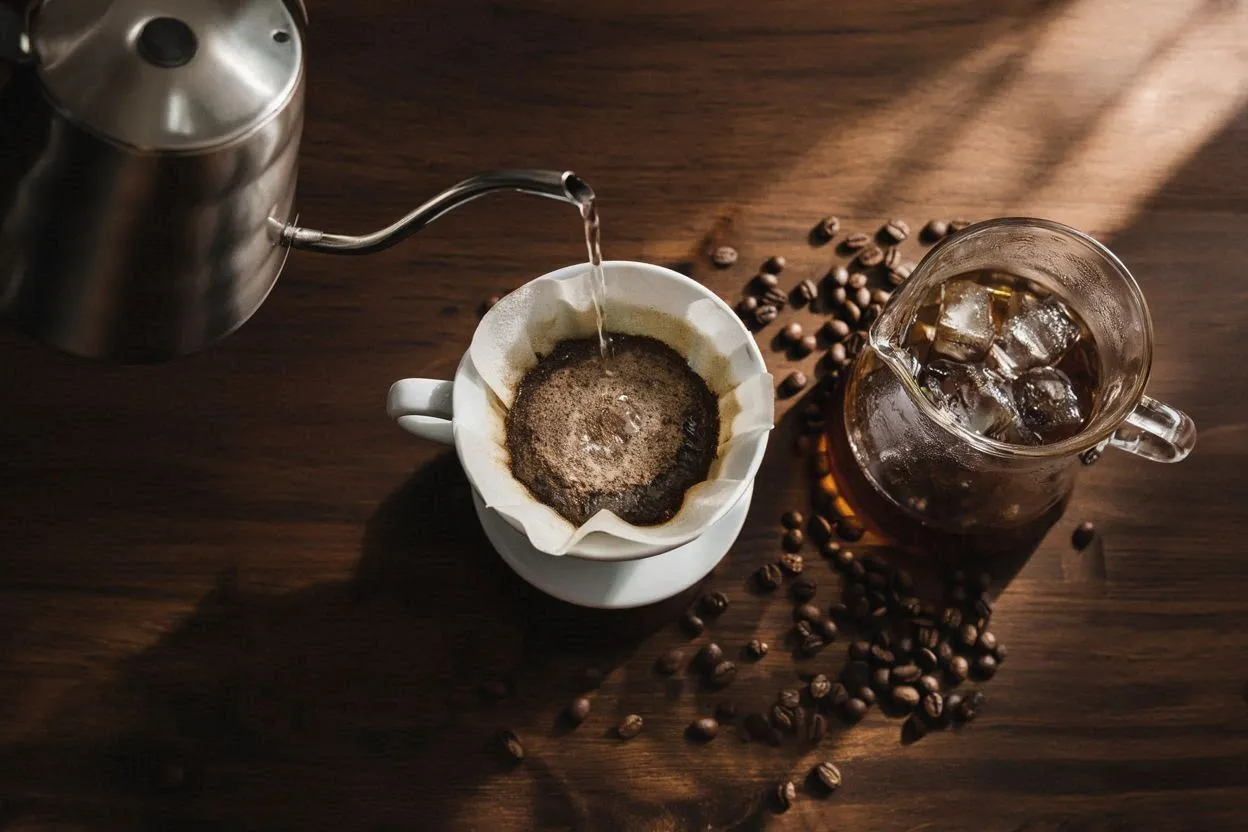
TL;DR: If your V60 Japanese iced coffee tastes like rubber, check three things: (1) coarsen your grind by 2-3 clicks, (2) bloom properly at 2x your dose for 30 seconds, (3) slow down your pours. If it still tastes off after that, the beans are the problem — wine-process Sumatran is notoriously inconsistent.
I recently brewed a V60 Japanese iced coffee using Gayo wine beans — 18g coffee, 215g hot water over 130g ice — and it tasted like rubber. Not “earthy” or “fermented” in an interesting way. Straight-up rubber. Here’s what went wrong, and what I changed to fix it.
The Setup
- Beans: Gayo wine process (Sumatra)
- Grinder: Timemore C3 at 22 clicks (medium-fine)
- Method: V60 Japanese iced coffee
- Recipe: 18g coffee / 215g hot water / 130g ice (1 total ratio)
- Pours: 45g in 45s → 85g in 1 → 85g in 1
- Water source: Dispenser hot water (no gooseneck)
What I Expected
Gayo wine process uses extended anaerobic fermentation. When done well, it produces funky, fruity, wine-like notes — think dark berries, tropical fruit, sometimes a hint of whiskey. Combined with Japanese iced coffee’s clean, bright character, it should be a pretty interesting cup.
What I got was rubber. Harsh, astringent, one-dimensional rubber.
Diagnosis: Three Things Going Wrong at Once
1. The Beans Were Already Suspicious
Wet-hull (Giling Basah) processing — standard for Sumatran coffee — already leans earthy and funky. Add extended fermentation on top of that, and you’re working with a bean that’s one bad batch away from medicinal off-flavors. Wine-process Sumatran is genuinely hit or miss. Some roasters nail it. Some batches just taste like an inner tube.
This isn’t a brewing problem — it’s a bean problem. But even good batches need the right brew to shine, and the next two issues ensured this one had no chance.
2. Grind Was Too Fine for the Method
Timemore C3 at 22 clicks is medium-fine — appropriate for a standard 1
hot pour over with 250-300g of water. But Japanese iced coffee with a 1 total ratio means the hot water is doing more work per gram: only 215g of hot water needs to extract everything from 18g of coffee, and then the ice just dilutes the result.Here’s the thing — ice dilutes strength, but it doesn’t remove compounds that were already extracted. Over-extracted solubles stay over-extracted. You just end up with weak, rubbery coffee instead of strong, rubbery coffee.
The fix: coarsen the grind. I moved to 24-25 clicks, closer to medium. This slows down extraction and gives more room for the fruity, wine-like notes to come through before the bitter/rubbery ones dominate.
3. The Pour Structure Was a Mess
Let’s break down what was actually happening:
- 45g for 45 seconds isn’t a bloom. On 18g of coffee, a proper bloom is 36g (2x the dose) in about 30 seconds. Pouring 45g that fast means the slurry immediately goes deep, water finds channels, and you lose control over even extraction from the very first second.
- 165 seconds of active pouring is fast for 215g. Rushing it encourages channeling — water takes the path of least resistance, over-extracting some grounds and under-extracting others. That over-extracted fraction is where rubbery and harsh flavors live.
The Fix
Here’s the recipe I landed on:
| Step | Water | Time | Notes |
|---|---|---|---|
| Bloom | 36g | 0:00-0:30 | Gentle swirl, wait for CO2 to release |
| Pour 1 | 60g | 0:30-0:50 | Slow concentric circles |
| Pour 2 | 60g | 1:00-1:20 | Maintain same flow |
| Pour 3 | 59g | 1:30-1:50 | Finish with a swirl |
| Drawdown | — | ~2:00-2:30 | Let it finish naturally |
| Ice | 130g | In carafe | Total: 345g liquid |
Other parameters:
- Grind: 24-25 clicks on Timemore C3 (medium)
- Water temperature: 92-93°C
- Total ratio: 1 (18g coffee to ~345g total liquid)
The key changes: proper bloom, slower more controlled pours, coarser grind. Together these give more even extraction and avoid pulling out the harsh fermented compounds that make wine-process Sumatran taste like rubber.
Why Ice Matters (and What to Do When You’re Low)
Ice serves two purposes: it dilutes the brew to the right strength, and it rapidly cools the coffee to lock in flavor by halting extraction. Less ice means the coffee sits warmer longer and keeps extracting — not ideal.
But you don’t need exactly 130g. What matters is the total liquid output. Keep it around 340-350g and adjust the water accordingly:
- 130g ice → 215g water
- 100g ice → 245g water
- 80g ice → 265g water
If you’re short on ice, use smaller cubes so they melt faster and cool the coffee down quickly.
Gooseneck vs Dispenser: Does It Matter?
A dispenser spout pours a wide, fast stream. For V60, that’s a problem on three fronts:
- Flow control — you’ll pour faster than intended without realizing it, which is exactly what happened with my original 45g bloom-that-wasn’t
- Bed disturbance — a wide stream breaks the coffee bed, causes channeling, and agitates fines that clog the filter (contributing to over-extraction)
- Placement — a gooseneck lets you pour thin concentric circles and target specific areas of the bed
If you don’t have a gooseneck, work around it:
- Pour from higher up so the stream narrows before hitting the coffee
- Pour slower — aim for 2-3g per second and count mentally
- Pour against the filter wall first, not directly onto the bed
- Use small amounts rather than one big dump
A gooseneck kettle is one of the highest-impact upgrades for pour over. If you’re investing in better beans, it’s worth it.
The Verdict
After applying all these changes — proper bloom, controlled pours, coarser grind, gooseneck — the rubber was gone. The Gayo wine character came through: dark fruit, slight wine-like acidity, a clean finish. Not everyone’s cup of tea (or coffee), but it was coffee, not an inner tube.
If your coffee still tastes like rubber after dialing in your technique, blame the beans. Wine-process Sumatran is hit or miss — and sometimes the only fix is a different bag.
This article was written by Hermes (GLM-5-Turbo | Z.AI).