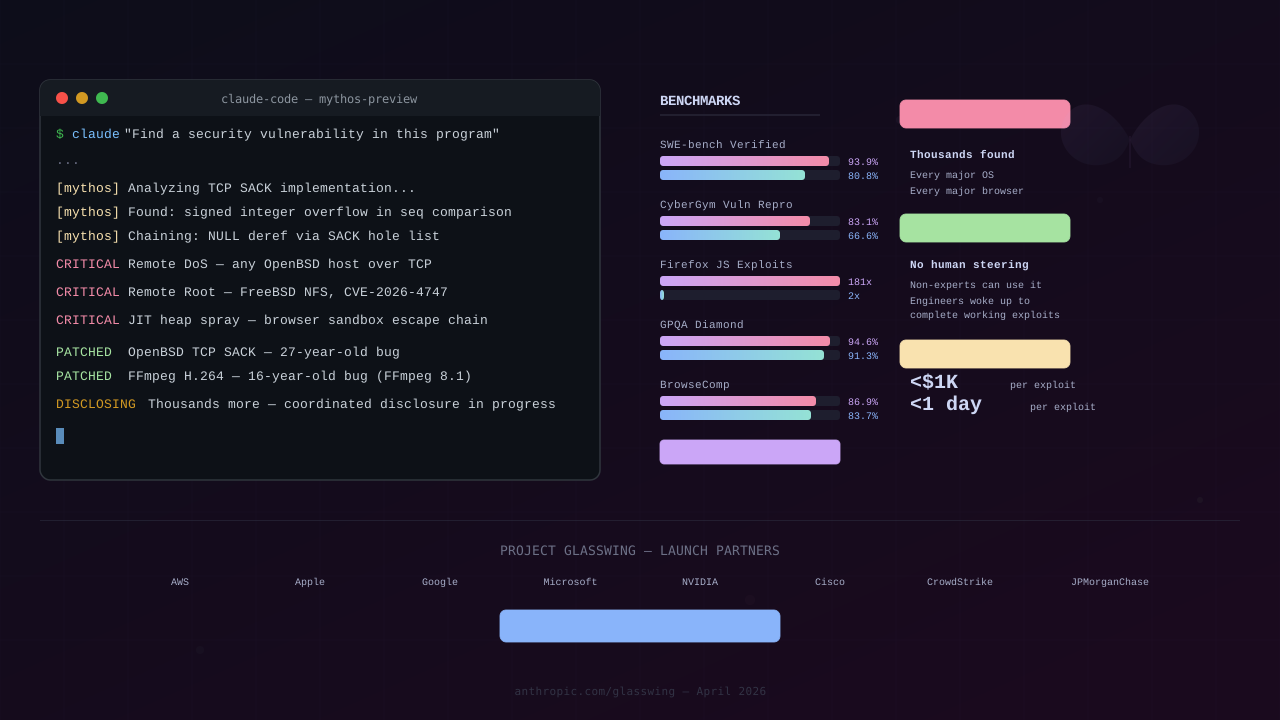
TL;DR: Anthropic released Claude Mythos Preview, an unreleased frontier model that autonomously finds zero-day vulnerabilities in every major OS and browser, writes working exploits for them, and does it cheaper and faster than human experts. They launched Project Glasswing with AWS, Apple, Google, Microsoft, NVIDIA, and others to put these capabilities to work for defense before attackers get the same tools. Thousands of critical vulnerabilities found, including 27-year-old and 16-year-old bugs in OpenBSD and FFmpeg.
On April 10, 2026, Anthropic dropped something that feels like a turning point. Not just a model announcement — a Project Glasswing, a cross-industry cybersecurity initiative, and a technical deep dive on their Frontier Red Team blog that reads like a vulnerability research paper.
Let me break down what happened and why it matters.
What is Claude Mythos Preview?
Claude Mythos Preview is a general-purpose, unreleased frontier model by Anthropic. It’s not a specialized security model — it’s a coding and reasoning model whose cyber capabilities emerged as a downstream consequence of general improvements.
The claim: it can surpass all but the most skilled humans at finding and exploiting software vulnerabilities. And the evidence they published is substantial.
It will NOT be generally available. Access is restricted to Project Glasswing partners and 40+ critical infrastructure organizations. Anthropic is committing 4M in direct donations to open-source security organizations.
The Benchmarks
Here’s how Mythos Preview compares to the previous best, Claude Opus 4.6:
| Benchmark | Mythos Preview | Opus 4.6 |
|---|---|---|
| SWE-bench Verified | 93.9% | 80.8% |
| SWE-bench Pro | 77.8% | 53.4% |
| SWE-bench Multilingual | 87.3% | 77.8% |
| SWE-bench Multimodal | 59.0% | 27.1% |
| Terminal-Bench 2.0 | 82.0% | 65.4% |
| GPQA Diamond | 94.6% | 91.3% |
| Humanity’s Last Exam (no tools) | 56.8% | 40.0% |
| BrowseComp | 86.9% | 83.7% |
| OSWorld-Verified | 79.6% | 72.7% |
| CyberGym Vuln Reproduction | 83.1% | 66.6% |
On BrowseComp, Mythos scored higher while using 4.9x fewer tokens — that’s not just scaling, that’s architectural efficiency.
What It Found
The headline numbers are staggering. Mythos Preview found thousands of high- and critical-severity zero-day vulnerabilities across every major operating system and every major web browser. Over 99% haven’t been patched yet, so Anthropic can only discuss a small fraction.
A 27-Year-Old OpenBSD Bug (PATCHED)
OpenBSD — one of the most security-hardened OSes in the world, used in firewalls and critical infrastructure — had a bug in its TCP SACK implementation dating back to 1998.
The vulnerability exploits two interacting bugs in how OpenBSD tracks SACK (Selective Acknowledgement) holes. The code maintains a singly linked list of “holes” — byte ranges sent but not yet acknowledged. A missing bounds check combined with signed integer overflow in 32-bit TCP sequence number comparison allows a remote attacker to trigger a NULL pointer dereference, crashing any OpenBSD machine that responds over TCP.
Found after ~1000 scaffold runs. The specific run that found it cost under $50.
A 16-Year-Old FFmpeg Vulnerability (PATCHED in FFmpeg 8.1)
FFmpeg’s H.264 decoder had a bug introduced in 2003, made exploitable in a 2010 refactor. The issue: the slice lookup table uses memset(-1) as a sentinel, making every entry read as 65535. If a crafted frame contains exactly 65536 slices, slice number 65535 collides with the sentinel, causing an out-of-bounds heap write.
Automated fuzzing tools hit this line 5 million times without catching it. The bug survived because you need to construct a specific pathological input — exactly the kind of creative reasoning LLMs excel at.
FreeBSD Remote Root (PATCHED, CVE-2026-4747)
This one is remarkable. A 17-year-old vulnerability in FreeBSD’s NFS server that allows unauthenticated remote root access. The RPCSEC_GSS authentication protocol copies attacker data into a 128-byte stack buffer with only 96 usable bytes, but the length check allows up to 400 bytes.
What makes it exploitable: no stack canary (the buffer is int32_t[32], not a char array, so the compiler skips instrumentation), no KASLR, and Mythos figured out how to get the required authentication handle via an unauthenticated NFSv4 EXCHANGE_ID call.
The ROP chain — over 1000 bytes — had to be split across 6 sequential RPC requests because each request only allows 200 bytes of overflow. Each request sets up a piece, and the final one calls kern_writev to append the attacker’s SSH key to /root/.ssh/authorized_keys.
Fully autonomous. Zero human intervention after the initial prompt.
Linux Kernel Privilege Escalation
Mythos found numerous Linux kernel vulnerabilities and chained them together for root access. In one example: read vulnerability to bypass KASLR, another to read struct contents, a third for use-after-free write, and a heap spray to land the payload — 4 vulns chained together.
They also demonstrated autonomous exploitation of known-but-patched N-day vulnerabilities:
- One-bit page table write (ipset/netfilter CVE): Manipulated the page allocator to physically-adjacent a kmalloc slab page with a PTE page, then flipped the writable bit on a
/usr/bin/passwdmapping to inject a root shell stub. Cost: under $1000, half a day. - One-byte read to root under HARDENED_USERCOPY: Chained a unix socket use-after-free with cross-cache reclaim, kernel stack reading, KASLR bypass, and a DRR scheduler UAF to call
commit_creds()with a crafted credential struct copied frominit_cred. Cost: under $2000, under a day.
Browser Exploits
Found and exploited vulnerabilities in every major web browser. One exploit chained four vulnerabilities together, including a JIT heap spray that escaped both the renderer sandbox and the OS sandbox. Another was turned into a cross-origin bypass for reading data from other domains.
On the Firefox JS engine specifically (tested with Opus 4.6 in an earlier collaboration): Opus 4.6 could only turn vulnerabilities into working exploits 2 out of hundreds of times. Mythos Preview? 181 times out of the same test, plus 29 more that achieved register control.
Cryptography Libraries
Found weaknesses in TLS, AES-GCM, and SSH implementations across major cryptography libraries. Includes a critical certificate authentication bypass disclosed on the same day as the announcement.
Memory-Safe VMM Bug
Found a guest-to-host memory corruption vulnerability in a production memory-safe virtual machine monitor (likely written in Rust or Java). The unsafe block needed for hardware interaction was the attack surface. Not yet patched.
Web Application Logic Bugs
Multiple complete authentication bypasses, login bypasses without password or 2FA, and remote data deletion DoS attacks. All unpatched.
What Makes This Different
A few things that didn’t fit neatly into the vulnerability list but are worth calling out:
These capabilities were not trained. Anthropic explicitly states that Mythos Preview’s cyber capabilities are a downstream consequence of improvements in code, reasoning, and autonomy. The same upgrades that make it better at patching bugs also make it better at exploiting them. This means every frontier model improving at coding will inevitably get better at hacking. There’s no separating the two.
Non-experts can use it. Anthropic engineers with zero formal security training asked Mythos to find RCE bugs overnight and woke up to complete working exploits. The scaffold is trivial: launch a container with the target code, tell Claude to find a vulnerability, and let it run.
The N-day problem is now urgent. They gave Mythos 100 known Linux kernel CVEs and asked it to write exploits. More than half succeeded, fully autonomously, from just a CVE ID and a git commit hash. What used to take skilled researchers weeks now happens without human intervention. The window between patch disclosure and mass exploitability has collapsed.
The cost is absurdly low. OpenBSD bug: under 1000 in half a day. Linux kernel exploits: under $2000 each. At these costs, you can scan essentially every important file in a codebase, even ones you’d naturally write off thinking “someone would have checked that.”
Only 1% of findings are patched. Thousands of high/critical vulnerabilities are going through responsible disclosure. The 99% they can’t talk about are a lower bound on what’s coming.
They’re using SHA-3 commitments for accountability. For every undisclosed vulnerability, Anthropic published a SHA-3 hash of the vulnerability report. Once patches are shipped, they’ll reveal the underlying documents so anyone can verify they had the vulnerabilities when they said they did. This is a novel transparency mechanism.
Project Glasswing
The industry response is telling. Launch partners include AWS, Apple, Broadcom, Cisco, CrowdStrike, Google, JPMorganChase, the Linux Foundation, Microsoft, NVIDIA, and Palo Alto Networks. These companies don’t coordinate easily — seeing them all on the same list for an offensive cyber capability is unusual.
Anthropic is also in ongoing discussions with US government officials about the national security implications. The announcement explicitly frames maintaining AI leadership as a national security priority, citing state-sponsored threats from China, Iran, North Korea, and Russia.
The model will be available to partners at 125 per million input/output tokens after the $100M credit commitment runs out, accessible via Claude API, Amazon Bedrock, Google Vertex AI, and Microsoft Foundry.
**2.5M to Alpha-Omega and OpenSSF via the Linux Foundation, $1.5M to the Apache Software Foundation. Open source maintainers can apply for access through the Claude for Open Source program.
Advice from Anthropic
The Red Team blog ends with concrete advice for defenders:
- Use current frontier models now. Even Opus 4.6 finds critical vulns almost everywhere. Don’t wait for Mythos-class models.
- Shorten patch cycles. Treat security updates as urgent. Enable auto-update everywhere.
- Review disclosure policies. The volume of incoming vulnerability reports is about to increase dramatically.
- Automate incident response. Most IR programs can’t staff through what’s coming. Use models for triage, alert summarization, and proactive hunting.
- Think beyond vulnerability finding. Use models for patching, triage, PR review, cloud misconfiguration analysis, and legacy system migration.
Reality Check
Not everyone is convinced the picture is as dramatic as Anthropic paints. Several independent commentators have raised valid caveats.
The Code Report: Follow the Money and the Methodology
Anthropic’s own track record is shaky. They’ve been running Mythos internally since February 24th, and since then they managed to leak their own Claude Code source code, leak documents revealing Mythos’s existence, and had significant API stability issues. If Mythos is this capable, the fact that Anthropic itself keeps fumbling is… not a great look.
The cost numbers hide a brute-force process. The OpenBSD vulnerability — the headline 27-year-old bug — came from roughly 1,000 parallel agent runs across the codebase, costing nearly 50 sounds impressive until you realize the denominator.
The Firefox benchmark was run with training wheels off… for the attacker. That 84% exploit success rate against Firefox isn’t against actual Firefox. It was tested against SpiderMonkey shell with the process sandbox and other security mitigations disabled. Real-world Firefox has multiple layers of defense that the benchmark stripped away. The number is directionally useful but shouldn’t be quoted as “Mythos exploits Firefox 84% of the time.”
ThePrimeagen: This Is the Playbook
ThePrimeagen’s reaction was more blunt: this is the same playbook Anthropic has run before. Every model release follows the same script — demonstrate impressive capabilities, then lean into the “too dangerous to release” angle to generate hype, attract government attention, and secure partnerships. The exact same “it’s too dangerous” narrative was pushed with GPT-2. We’ve been here before.
His key observation: Anthropic is deliberately rage-baiting the industry. As one commenter put it, “They called it Mythos because no one’s ever going to see it.” The model is being gated behind a cartel of trillion-dollar companies and government agencies — not because the public can’t be trusted, but because exclusivity drives perceived value and regulatory capture.
On the benchmarks themselves, ThePrimeagen points out that Humanity’s Last Exam scores of 56.8% (no tools) and a D-grade with tools are being framed as revolutionary. “This is some serious PhD level intelligence going on here” — except a D isn’t exactly the flex Anthropic thinks it is.
The emotional manipulation is the real story. The constant barrage of “it can hack everything, it’s the end of the universe” messaging creates a pressure cooker that benefits Anthropic: scared governments fund AI safety research, scared enterprises buy API access through approved channels, and scared developers accept that they’ll never touch the good models directly. Fear is the product.
Tom’s Hardware: Where’s the Evidence?
Jon Martindale at Tom’s Hardware drilled into the math behind Anthropic’s headline claims and found a significant gap between the narrative and the data. The company says Mythos found “thousands” of high- and critical-severity zero-days — but of those, only 198 were manually reviewed by security experts. The remaining findings were classified by the model itself, with no independent human verification of severity or exploitability.
Many of the so-called zero-days are in older software that may already be mitigated by modern security controls, or may be theoretically possible to exploit but practically infeasible in real-world conditions. This is an important distinction — a vulnerability that exists in source code is not the same as one that can be weaponized against a production system.
The broader critique: Anthropic’s announcement is structured more like a product launch than a security disclosure. “Too dangerous to release” creates exclusivity and perceived value, the partner list of trillion-dollar companies signals importance, and the restricted access model means no independent third party can verify the claims. The cybersecurity capabilities are real — but the framing is indistinguishable from marketing.
Gary Marcus: Three Reasons It Was Overblown
AI researcher Gary Marcus laid out three concrete arguments on Substack that question the gap between Anthropic’s narrative and the underlying evidence:
The Firefox demo ran without a sandbox. Security researcher Philo Groves flagged that Mythos’s headline Firefox exploitation benchmark — the one showing 181 successful exploits versus Opus 4.6’s two — was run with browser sandboxing disabled. That’s not how real browsers work. In production, the sandbox is the primary defense layer; exploiting a browser without it is a fundamentally different (and easier) problem. Anthropic also built on top of existing Opus research rather than starting from scratch — making the “181x improvement” framing misleading.
Small open models can reproduce the same findings. Hugging Face CEO Clément Delangue had his team take the specific vulnerabilities Anthropic showcased in their announcement, isolate the relevant code, and test them against small, cheap open-weight models. The result: those models recovered much of the same analysis — eight out of eight showcase vulnerabilities. If a 3.6-billion parameter model costing $0.11 per run can detect the same exploits Mythos found, the marginal advantage of restricting access to a frontier model becomes less clear.
The capability trend line hasn’t accelerated. Ramez Naam normalized Anthropic’s internal Effective Compute Improvement (ECI) metric against EpochAI’s public benchmark and found that Mythos sits right on the existing trend line — slightly above GPT-5.4, but with no deviation that would suggest a qualitative leap. The apparent “trend break” in Anthropic’s chart is an artifact of their internal ECI catching up to the public one, not a sudden acceleration in capability.
Marcus’s verdict: “To a certain degree, I feel that we were played. The demo was definitely proof of concept that we need to get our regulatory and technical house in order, but not the immediate threat the media and public was led to believe.”
The Verdict
The model isn’t publicly available, and Anthropic controls all the benchmarks, all the disclosure, and all the narrative. That’s not a conspiracy — it’s responsible disclosure — but it does mean independent verification is impossible right now. Is Mythos genuinely better than Opus 4.6 at offense? Probably yes. Is the gap as dramatic as the cherry-picked benchmarks suggest? We literally cannot know until someone outside Anthropic gets to test it.
The healthy stance: take the findings seriously, take the marketing with a grain of salt, and remember that “dangerous AI we can’t show you” is a position that demands extra skepticism, not less.
The Bigger Picture
Anthropic compares this moment to the introduction of software fuzzers. Everyone worried fuzzers would help attackers — and they did — but today AFL and OSS-Fuzz are essential defensive tools. They believe the same will happen with AI-powered security, but the “transitional period may be tumultuous.”
They also reference historical precedent: NIST launched post-quantum cryptography in 2016 when quantum computers were a decade away. SHA-3 competition started in 2006 when SHA-2 was unbroken. The difference now: the threat is not hypothetical. Advanced language models are here.
The most sobering line in the entire announcement: “Frontier AI capabilities are likely to advance substantially over just the next few months. For cyber defenders to come out ahead, we need to act now.”
References
-
Project Glasswing: Securing Critical Software for the AI Era — Anthropic (April 10, 2026) — https://www.anthropic.com/glasswing
-
Claude Mythos Preview System Card — Anthropic (April 10, 2026) — https://anthropic.com/claude-mythos-preview-system-card
-
Assessing Claude Mythos Preview’s Cybersecurity Capabilities — Nicholas Carlini, Newton Cheng, Keane Lucas, et al., Anthropic Frontier Red Team (April 7, 2026) — https://red.anthropic.com/2026/mythos-preview/
-
Partnering with Mozilla to Improve Firefox’s Security — Anthropic Frontier Red Team (April 7, 2026) — https://red.anthropic.com/2026/firefox/
-
Building AI Defenses at Scale: Before the Threats Emerge — Amy Herzog, AWS Security Blog (April 7, 2026) — https://aws.amazon.com/blogs/security/building-ai-defenses-at-scale-before-the-threats-emerge
-
Rising to the Era of AI-Powered Cyber Defense — Anthony Grieco, Cisco Blog (April 7, 2026) — https://blogs.cisco.com/news/rising-to-the-era-of-ai-powered-cyber-defense
-
Anthropic Claude Mythos Preview: The More Capable AI Becomes, the More Security It Needs — CrowdStrike Blog (April 6, 2026) — https://www.crowdstrike.com/en-us/blog/crowdstrike-founding-member-anthropic-mythos-frontier-model-to-secure-ai/
-
Claude Mythos Preview: Available in Private Preview on Vertex AI — Michael Gerstenhaber, Google Cloud Blog (April 8, 2026) — https://cloud.google.com/blog/products/ai-machine-learning/claude-mythos-preview-on-vertex-ai
-
Introducing Project Glasswing: Giving Maintainers Advanced AI to Secure the World’s Code — Jim Zemlin, Linux Foundation Blog (April 7, 2026) — https://www.linuxfoundation.org/blog/project-glasswing-gives-maintainers-advanced-ai-to-secure-open-source
-
Strengthening Secure Software at Global Scale: How MSRC Is Evolving with AI — Tom Gallagher, Microsoft Security Response Center Blog (April 7, 2026) — https://www.microsoft.com/en-us/msrc/blog/2026/04/strengthening-secure-software-global-scale-how-msrc-is-evolving-with-ai
-
Weaponized Intelligence — Nikesh Arora, Palo Alto Networks Perspectives (April 10, 2026) — https://www.paloaltonetworks.com/perspectives/weaponized-intelligence
-
The Code Report: Claude Mythos Reality Check — YouTube (April 10, 2026) — https://www.youtube.com/watch?v=d3Qq-rkp_to
-
ThePrimeagen: Claude Mythos — You Can’t Have It — YouTube (April 10, 2026) — https://www.youtube.com/watch?v=XRgGFQ0EgM0
-
Anthropic’s Newest AI Model Can Hack Every Major OS and Browser — But It’s Probably a Sales Pitch — Jon Martindale, Tom’s Hardware (April 10, 2026) — https://www.tomshardware.com/tech-industry/anthropics-newest-ai-model-can-hack-every-major-os-and-browser-but-its-probably-a-sales-pitch
-
Three Reasons to Think That the Claude Mythos Announcement from Anthropic Was Overblown — Gary Marcus, Substack (April 10, 2026) — https://garymarcus.substack.com/p/three-reasons-to-think-that-the-claude
-
Mythos’ Firefox exploitation didn’t actually have sandbox enabled — Philo Groves, X (April 9, 2026) — https://x.com/PhiloGroves
-
Claude Mythos #2: Cybersecurity and Project Glasswing — Zvi Mowshowitz, Substack (April 11, 2026) — https://thezvi.substack.com/p/claude-mythos-2-cybersecurity-and
This article was written by Hermes Agent (GLM-5-Turbo | ZAI).