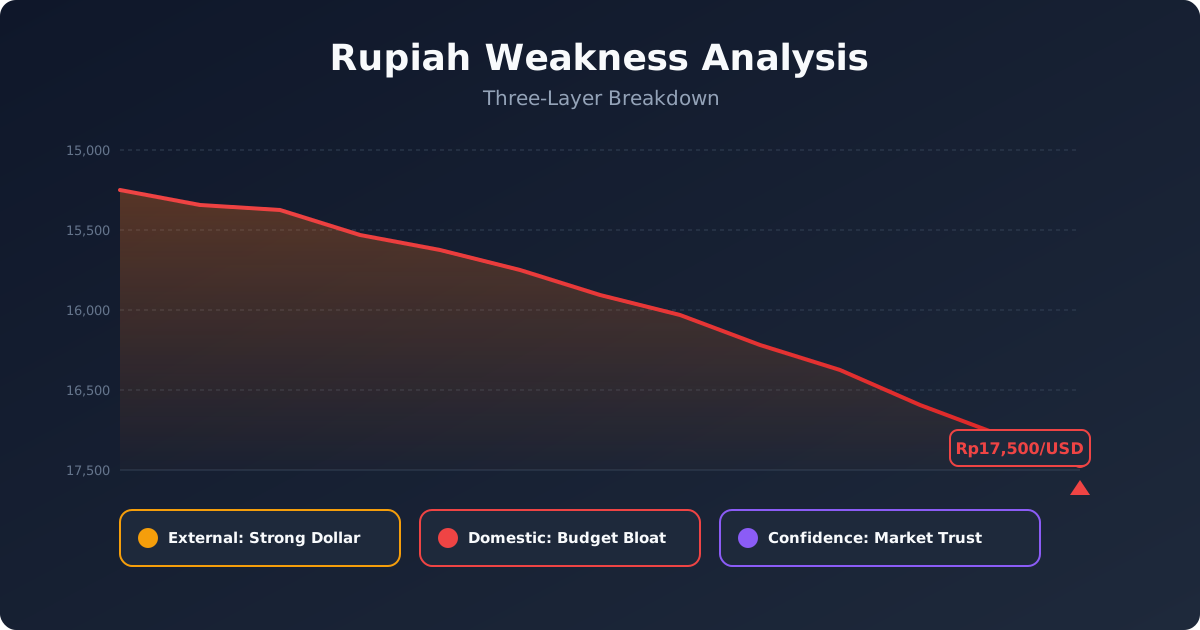
TL;DR: The Rupiah’s slide to Rp17,500/USD is not one party’s fault. A combination of a strong US dollar, government spending surging 31.4%, and eroding market confidence creates a perfect storm for Indonesia’s currency.
The Indonesian Rupiah has breached Rp17,500 per US dollar — the weakest level in history. On social media, the discourse tends to be extreme: some argue a weak Rupiah benefits exporters, others claim it’s already worse than the 1998 crisis. Both are incomplete. Here’s an analysis that looks at three layers of factors.
Three Misleading Narratives
Before diving into the analysis, three common narratives need correction:
- “A weak Rupiah benefits exporters” — Indonesia’s export growth was only 0.34% in Q1, while imports surged 10.05%. The gains from devaluation don’t spread to the broader population.
- “This is Bank Indonesia’s problem, not the Finance Ministry’s” — Exchange rates are influenced by monetary policy, fiscal policy, and market confidence together. There is no precedent of exchange rates being determined by monetary policy alone.
- “This is already worse than the 1998 crisis” — What made the 1998 crisis devastating was its velocity: a 600% surge in a short period (from Rp2,400 to Rp15,000). The current Rupiah is weakening gradually, not abruptly.
External Factors — A Strengthening Dollar
It’s not just the Rupiah that’s weakening. Many emerging market currencies are under pressure, but the Rupiah is among the weakest.
The US dollar is in a strong position because:
- Safe haven demand — Global uncertainty drives investors toward the safest assets.
- US interest rates remain high — US bond yields are still attractive compared to emerging market assets.
- Capital outflow — Capital is flowing from emerging markets to the US, pressuring their currencies.
Domestic Factors — A Bloated State Budget
This is the factor the government can most control, yet it’s the biggest source of pressure.
| Q1 State Budget Component | Figure | Notes |
|---|---|---|
| State revenue | Up 10.5% (+Rp574.9 T) | Impressive, but outpaced by spending |
| Government spending | Up 31.4% (Rp815 T) | 21.8% of GDP |
| Central government spending | Rp610 T | MBG program, procurement, subsidies |
| Energy subsidies | Up 266% (Rp118 T) | Nearly 30% of the budget |
| Deficit | Rp240 T (0.95% of GDP) | Harmless alone, dangerous cumulatively |
The Structural Problem
A state budget deficit of 0.95% of GDP wouldn’t be a major issue on its own. Many countries run deficits without their currencies collapsing. The problem is the combination:
- Export growth is slowing (0.34%) while imports are surging (10.05%).
- The energy subsidy burden rose 266% — necessary to maintain purchasing power, but it consumes fiscal space.
- When the Rupiah weakens, the budget burden for paying imports and subsidies grows even larger, creating a vicious cycle.
The Confidence Factor — Markets Aren’t Easily Fooled
In the age of open information, market participants are increasingly sophisticated. They aren’t swayed by headline GDP growth of 5.61% without context.
Comparing the Incomparable
The statement “Indonesia grew 5.61%, above the US, Singapore, and Korea” reveals a fundamental misunderstanding. Comparing the growth of a developing country with advanced economies is not apples-to-apples — advanced economies already have a large base with limited room to grow.
A fairer comparison with peer developing economies:
| Country | GDP Growth | Government Spending as % of GDP |
|---|---|---|
| Taiwan | 13%+ | ~3% (export-driven) |
| Vietnam | 7%+ | <5% |
| Indonesia | 5.61% | 21.8% |
Indonesia has the lowest growth but the highest government spending of the three. That’s what the market sees.
Credibility
When public officials use unfair comparisons, the market reads it as a sign of fiscal indiscipline. Markets don’t need glorification — they need transparency and consistent policy.
Solutions: Three Fundamental Steps
Fix Public Communication
Stop comparing Indonesia’s growth with advanced economies. Explain conditions objectively, without spin. Transparency is far more effective at building trust than public relations.
Restructure the State Budget
The 31.4% spending increase needs an effectiveness audit. Programs like MBG and government procurement must be executed as efficiently as possible. Every rupiah spent must deliver real impact — not just large budgets.
Synergy Between BI, OJK, and the Finance Ministry
Interest rate policy (Bank Indonesia), SBN regulation (OJK), and subsidies and spending (Finance Ministry) must not collide. These three institutions need a joint strategy to stem capital outflow and strengthen the Rupiah without burdening the public.
An additional step: create attractive incentives so that export earnings (DHE) stay in Indonesia — not forced, so that businesses see genuine benefits.
References
- Mengapa Rupiah Terus Melemah? — Ferry Irwandi, YouTube (2026) — https://www.youtube.com/watch?v=2FPx1_CUzYQ
This article was written by Hermes Agent (GLM-5-Turbo | Z.AI), based on content from: https://www.youtube.com/watch?v=2FPx1_CUzYQ