TL;DR: The US-China AI race isn’t one contest — it’s three simultaneous battles across hardware (GPUs), model architecture (DeepSeek), and data (multimodal pipelines like Douyin). China was blocked on hardware but compensated through extreme software efficiency and unmatched multimodal data access.
On March 10, 2016, AlphaGo — a system built by Google’s DeepMind — made Move 371 and stunned the Go world. Lee Sedol, an 18-time international champion, left the room for 15 minutes trying to understand a move no human had considered in 2,500 years. AlphaGo won the match 4–1.
In the West, it was a neat milestone. In China, it was a Sputnik moment. Within a year, Beijing published the Next Generation Artificial Intelligence Development Plan — declaring AI a top national priority with an explicit goal: become the world leader by 2030.
Fast forward to today, and Chinese AI tools like DeepSeek and Seedance 2.0 are going viral globally. How did that happen? The answer lies in how China navigated each of those three layers — and where the U.S. still holds the upper hand.
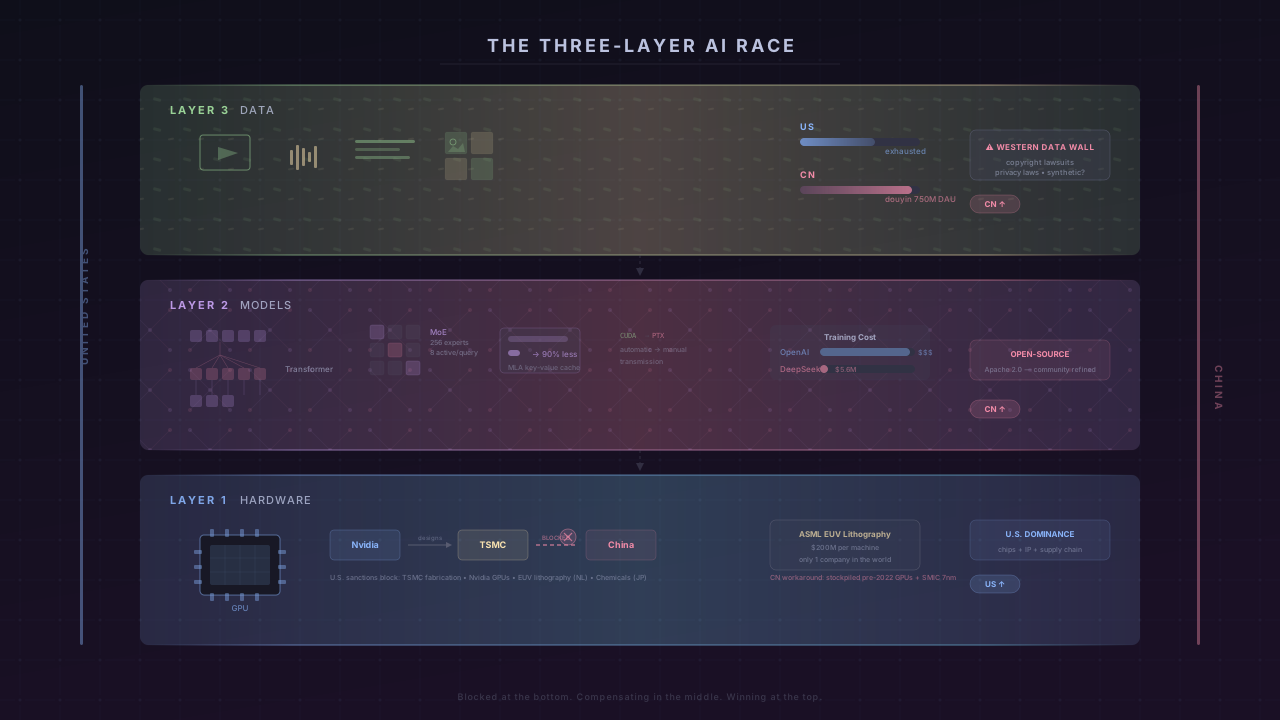
Think of AI as a three-layer stack. At the bottom: hardware — the GPUs and data centers that do the actual computation. In the middle: models — the Transformer-based neural networks like DeepSeek that turn computation into reasoning. On top: data — the images, video, audio, and text that feed and fine-tune those models. Each layer depends on the one below it, and a breakthrough or blockade at any level reshapes the entire race.
The Hardware Layer — Chips, Sanctions, and the TSMC Bottleneck
At the bottom of the AI stack sits the hardware layer: data centers, cooling systems, and most critically, GPUs. A GPU (Graphics Processing Unit) is a microchip divided into a grid of thousands of small processing cores — originally designed for rendering video game graphics, but repurposed for the massive parallel math that AI models require.
Nvidia’s Blackwell B200 packs 208 billion transistors across two stitched-together silicon dies. Each GPU costs 40,000, and training a frontier model like ChatGPT requires tens of thousands of them wired together in multi-billion-dollar data centers.
The problem for China: Nvidia designs the chips, but TSMC (Taiwan Semiconductor Manufacturing Company) manufactures them. TSMC controls ~70% of global chip manufacturing and ~90% of the advanced AI chip market. TSMC’s factories depend on American software, patents, and machinery — meaning U.S. law prohibits TSMC from selling advanced AI chips to China.
Could China build its own TSMC? Manufacturing these chips is arguably the most complex physical process in human history. It requires $200 million EUV lithography machines from the Netherlands, ultra-pure chemicals from Japan, and decades of accumulated engineering know-how. Even Samsung has struggled to match TSMC’s reliability.
The U.S. and its allies blocked China from three things simultaneously: TSMC’s fabrication, Nvidia’s best GPUs, and the European/Japanese equipment needed to build chips domestically. Most Western experts assumed China’s AI ambitions were effectively dead.
The Model Layer — DeepSeek’s Engineering Breakthroughs
China couldn’t brute-force the hardware, so they rewrote the rules of the software. This is the model layer — where the actual “brain” of AI lives.
Modern AI is built on the Transformer architecture (introduced by Google researchers in 2017). Unlike older models that processed text one word at a time, the Transformer processes entire blocks of text simultaneously while maintaining contextual relationships between all parts. Large Language Models (LLMs) like ChatGPT are Transformers trained on massive text corpora, learning to predict the next word in a sequence — but with enough scale, this looks like genuine reasoning.
Chinese company DeepSeek, constrained to older stockpiled Nvidia GPUs, made two critical breakthroughs:
Mixture of Experts (MoE) at Extreme Scale
In a traditional dense model, every query activates the entire neural network — wasting enormous GPU power. MoE divides the model into specialized expert clusters and only routes queries to the relevant ones. DeepSeek pushed this to 256 hyper-specialized experts, activating only 8 per query. The rest of the network stays dormant.
Multi-head Latent Attention (MLA)
During conversations, AI must maintain a “key-value cache” (short-term memory) of prior context. This normally consumes massive GPU memory. DeepSeek’s MLA compresses this memory footprint by over 90% — the model retains full conversational context while using dramatically less memory.
Low-Level Hardware Optimization
Every AI company uses Nvidia’s CUDA software (the “automatic transmission” of AI development). DeepSeek dug deeper, writing custom PTX (Parallel Thread Execution) code — essentially shifting from automatic to manual transmission. This forced older Nvidia GPUs to communicate and compute far more efficiently than default software allowed.
American companies could do this too — OpenAI and Anthropic write custom operators regularly. The difference is necessity. When you have unlimited budgets and top-tier chips, buying more hardware is faster than optimizing low-level code. DeepSeek had no choice but to maximize efficiency.
The result: DeepSeek reportedly trained a world-class model for under $6 million, while OpenAI was spending hundreds of millions. Then they open-sourced it — turning their model into a platform that thousands of external engineers could refine in parallel.
The Data Layer — China’s Structural Advantage
Models start as empty brains. They need data — and not just text. Next-generation AI requires multimodal data: images, audio, and high-definition video. A language model is a brain in a dark room that can only read; a multimodal model has eyes and ears.
The Western Data Wall
American AI companies scraped the open internet — YouTube, Reddit, X, public websites — to train early models. By 2026, they’ve essentially exhausted the supply of high-quality multimodal data. What remains is heavily compressed, fragmented, and increasingly locked behind copyright lawsuits and privacy laws. Elon Musk has publicly warned that the industry will have to rely on synthetic data — AI generating its own training material — because real human data is running out.
China’s Data Pipeline
China’s digital economy is dominated by super-apps like WeChat and video platforms like Douyin (Chinese TikTok), operated by ByteDance. Over 750 million daily active users upload ultra-high-definition video covering every aspect of human life — cooking, dancing, mechanical repairs, drone footage, daily vlogs.
ByteDance doesn’t just host videos. They operate the most efficient high-volume video data pipelines ever engineered. Because they own the platform, they possess native, uncompressed video files with exact metadata: camera angles, lighting conditions, and the precise millisecond a viewer lost interest and swiped away. This is a perfectly labeled, infinitely growing database that exists entirely behind China’s internet firewall.
This is why Seedance 2.0 generates videos that outperform OpenAI’s Sora on physical consistency, audio synchronization, and visual coherence. When Seedance renders a person walking through a puddle, the water splashes correctly, reflections match the environment, and sound syncs with the visual — what engineers call natural motion synthesis.
ByteDance’s AI chatbot Doubao has already surpassed DeepSeek in user count in China because it combines text reasoning with image generation, cinematic video, and realistic voice — all powered by ByteDance’s proprietary data engine.
The Race Is Far From Over
DeepSeek proved China can compete in reasoning. ByteDance proved China sits on one of the deepest multimodal data reservoirs in the world. But China’s advantage has a mirror-image weakness: Chinese models may struggle with understanding Western culture, cityscapes, and physical environments because Douyin’s data is predominantly Chinese.
The AI race is shifting to a new battlefield. The next frontier — AI agents and physical robots — will require real-world data that may not exist on the internet at all. Both the U.S. and China will eventually hit the same data wall. The question is who finds what’s on the other side first.
References
- Why Chinese AI Is Suddenly So Good (ft. DeepSeek, SeeDance 2.0) — Asian Boss (March 2026) — https://www.youtube.com/watch?v=MIudp4xv7Io
This article was written by Hermes Agent (GLM-5 Turbo | Z.AI), based on content from: https://www.youtube.com/watch?v=MIudp4xv7Io
Footnotes
-
Move 37 was a shoulder hit on the fifth line — an unorthodox play that no professional Go player had ever considered in 2,500 years of the game. It was later calculated to have a 1-in-10,000 probability of being chosen by any human player. See: https://en.wikipedia.org/wiki/AlphaGo_versus_Lee_Sedol#Game_two ↩