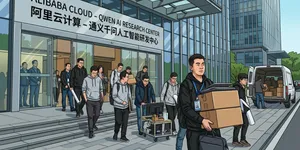
TL;DR: Chinese tech companies are forcing engineers to document their workflows so AI can replace them. A viral GitHub tool called Colleague Skill proved it’s already possible — and workers responded with anti-distillation sabotage tools, landmark court victories rejecting AI replacement as grounds for dismissal, and a broader generational revolt that includes mass emigration (润学) and the “rat people” movement.
On March 30, 2026, Tianyi Zhou — a 24-year-old engineer at the Shanghai Artificial Intelligence Laboratory1 — spent four hours building a prank. The result: Colleague Skill, a GitHub project that takes a coworker’s name and chat history from workplace apps like Lark or DingTalk, then generates an AI agent “skill file” capable of performing that person’s tasks in their voice — including punctuation habits.
It was meant as satire. The README tagline translates to: “You people working on large models are code traitors — you’ve already killed front-end developers and now want to kill back-end, testers, ops, security, IC engineers, and finally yourselves.”
It struck a nerve because it felt uncomfortably real. Within one week, the repo exceeded 8,400 GitHub stars. It sits at 19,378 ⭐ today with an arXiv paper backing it up2. And it triggered something bigger than anyone expected — a counter-movement built by workers who realized that if companies can distill them into AI replacements, they can also poison the pipeline.
The Distillation Playbook — Companies Already Doing This
Colleague Skill went viral not because it was novel, but because Chinese tech bosses were already pushing employees to document their workflows for AI training.
The catalyst was OpenClaw, an open-source AI agent tool that became a national craze in China. Once companies saw the potential, they started requiring engineers to:
- Formally document every step of their daily workflow
- Create manuals describing the minutiae of their roles
- Feed those materials into AI agents so the models can replicate human tasks
It’s not just automation — it’s an intelligence grab. Hancheng Cao, assistant professor at Emory University who studies AI and labor, explains that firms gain “richer data on employee know-how, workflows, and decision patterns.” The documentation reveals which parts of work can be standardized and which still depend on human judgment.
The spread was so rapid that government agencies and state-owned enterprises warned staff not to install OpenClaw on work devices — citing cybersecurity concerns. But corporate appetite for automation only sharpened3.
Colleague Skill — How It Actually Works
Despite the viral narrative of “anti-AI,” Colleague Skill is actually the distillation tool itself4. It’s a legitimate knowledge retention system backed by Shanghai AI Lab’s Safety Center, created to preserve institutional knowledge when colleagues leave. Three use cases:
| Family | Use Case | What It Captures |
|---|---|---|
| Colleague | Coworker quits → auto-collect their chat logs + docs | Work capabilities (technical standards, workflows) + Persona (communication style, decision patterns) — a 6-layer personality architecture |
| Relationship | Distill exes, partners, parents, close friends | Emotional triggers, conflict patterns, repair patterns |
| Celebrity | Public figures and fictional characters | Six-dimension research: writings → conversations → expression DNA → decisions → external views → timeline |
The tool collects from Feishu (飞书), DingTalk (钉钉), Slack, WeChat chat history (SQLite export via third-party tools), email (.eml/.mbox), PDFs, images, and screenshots. The output is a structured colleague.skill/ directory:
colleague.skill/├── SKILL.md # Entry point — the persona definition├── work.md # Technical standards, workflows, output preferences├── persona.md # 6-layer personality architecture├── meta.json # Metadata (name, tags, knowledge sources)└── manifest.json # AgentSkills standard packagingAmber Li, a 27-year-old tech worker in Shanghai who tested it on a former coworker: “It’s surprisingly good. It even captures the person’s little quirks.”5
The arXiv paper by Tianyi Zhou et al. frames it as expert knowledge distillation — automated trace-to-skill generation for creating person-grounded AI agents6. It was never anti-AI. That came next.
The Counter-Strike — Koki Xu’s Anti-Distillation Tool
If Colleague Skill proved that companies could replace workers with AI, someone needed to prove the opposite: you can poison the training data so the replacement is useless.
On April 4, 2026, Koki Xu (GitHub handle: leilei926524-tech) — a 26-year-old AI product manager in Beijing with law degrees7 — published an “anti-distillation” skill on GitHub. The tool works by rewriting workflow documentation into vague, non-actionable language that produces less useful AI stand-ins.
It has three sabotage modes:
| Mode | What It Does |
|---|---|
| Light | Subtle data corruption — enough to reduce model quality without obvious signs |
| Medium | Moderate degradation — the resulting agent is unreliable in key decision paths |
| Heavy | Complete poisoning — workflow documentation becomes generic, non-actionable language that produces a useless AI stand-in |
The logs look authentic. Bosses can’t tell anything wrong because the tool’s output mimics real work patterns. But the training data underneath is corrupted — like feeding a model on hallucinated textbooks and expecting it to pass exams8.
Xu told MIT Technology Review: “I originally wanted to write an op-ed, but decided it would be more useful to make something that pushes back against it.” His video about the tool pulled over 5 million likes in China alone9.
The legal angle is sharper. Xu raises a question no company has answered: while chat history on company laptops may be corporate property, capturing personality, tone, and judgment blurs ownership lines. Who owns your cognitive fingerprint?10
The Worker Playbook — Three Lines of Defense
Anti-distillation tools are just one pillar of worker resistance. Chinese tech workers have deployed three coordinated strategies:
1. Technical Resistance — Poisoning the Pipeline
Beyond Xu’s repo, workers use selective export controls — removing or redacting personal stylistic signals from logs before exporting them to company systems. The dark humor is equally telling: a joke circulating among Shanghai engineers goes “a cold farewell can be turned into warm tokens” — if you distill your coworkers before they distill you, you might survive layoffs longer11.
2. Legal Resistance — Courts Reject AI Replacement as Dismissal Grounds
Two landmark cases in late 2025 and early 2026 established that AI replacement alone does not justify termination:
| Case | Date | What Happened | Court Ruling |
|---|---|---|---|
| Hangzhou | April 30, 2026 | QA supervisor (¥25K/month) replaced by LLMs. Company offered reassignment at ¥15K; when he refused, fired him with ¥311,695 compensation citing “organizational restructuring” | Unlawful dismissal — AI replacement does NOT constitute a “major change in objective circumstances” under China’s Labor Contract Law12 |
| Beijing | December 2025 | Map data collector fired after AI took over his role | Unlawful — “The company shifted the risks of technological iteration onto its employees.” The adoption of AI was a voluntary move to stay competitive, not an objective circumstance13 |
These rulings matter because they prevent companies from using AI as a pretext for mass layoffs. Even if workers can be replaced by AI, firing them still costs money and carries legal risk14.
3. Cultural Resistance — Viral Memes as Organizing
Workers process anxiety through bleak humor and viral posts. On Xiaohongshu (小红书) and Zhihu (知乎), a common question: “What’s the point of studying 16 years if a chatbot can do my job?”15 The memes aren’t just coping — they’re coordination. In a country where labor organizing is suppressed, shared humor becomes a substitute for collective bargaining.
The Generational Context — Why This Is Bigger Than AI
Anti-distillation tools didn’t emerge in a vacuum. They’re the latest front in a generational revolt that started five years ago with an essay titled “Lying Flat Is Justice” (躺平是正义).16
The Lying Flat Origin Story
In April 2021, someone who called himself “the kind-hearted traveler” posted a 200-word essay on a Chinese forum. His argument: he was tired of life. He wasn’t going to buy a house, get married, or have kids. He would simply lie flat — and the CCP could do nothing about it17.
The post should have died quietly like millions of complaints on social media. Instead, it got reposted millions of times because it described exactly how every young Chinese person was feeling. For 30 years, the deal had been simple: work hard → achieve prosperity. The essay said that deal was broken18.
Three Stages of Escalation
The lying flat movement didn’t stay quiet for long. It evolved through three stages:
Stage 1 — Full-Time Children (全职儿女) — By 2023, an estimated 16 million young Chinese adults were calling themselves “full-time children.” These are people with master’s degrees from Tsinghua or Peking University19 who moved back in with their parents and treated caregiving as a job. They cook dinner, drive parents to doctor appointments, take care of grandparents — for ¥4,000–8,000/month (1,100). It sounds like retirement, but it’s essentially an informal social safety net when the state fails to provide adequate unemployment benefits20.
Stage 2 — Rat People (鼠人) — By 2025, lying flat took its final form: “rat people.” The hashtag #ratpeople crossed 10 million views on Chinese social media before CCP censors deleted it. These are mostly Gen Z teenagers without jobs whose daily routine consists of staying in bed for 3 hours after waking, sleeping another 5 hours, not eating until parents wake them for dinner — then repeating21. Like rats: avoid light, rhythm, and societal expectations.
Stage 3 — Run Philosophy (润学) — The “run” here is a pun. In Mandarin, the character 润 sounds identical to both the English word “run” and 利润 (lìrùn), meaning “profitable.” So when young Chinese say they’re “running,” they mean: it’s profitable to leave the country22. What looks like in practice is a giant crowdsourced manual for emigration — Canadian Express Entry, Japanese high-skilled professional visas, Singapore Tech Pass. Detailed guides on what paperworks you need, what to say at immigration interviews, how to actually move23.
The Gao Shenwen Bombshell
In late 2024, Chinese economist Gao Shenwen — chief economist at one of China’s major state-owned brokerages — dropped three bombshells during an investor conference in Zhengzhou24:
- Chinese GDP growth has been overestimated by roughly 3 percentage points each year. The economic miracle was largely statistical fiction. Roughly 40–50 million people who should have had jobs don’t have jobs — the CCP is lying about employment.
- Post-pandemic China is made up of “vibrant old people and lifeless young people.” An entire generation has given up.
- Young Chinese are “turning off the lights and eating noodles” (关灯吃面) — investment slang for someone who’s down on their luck after losing money in stocks25.
Gao wasn’t some dissident living overseas. He was a state-loyal economist with insider access speaking the truth. Within 48 hours, his speech was deleted from Chinese internet and his social media accounts were wiped — but not before it went viral26.
The U.S. Parallel — Mercor Already Doing This
This isn’t new in concept. American startup Mercor has spent years hiring laid-off professionals — journalists, lawyers, video editors — to train AI models on the very jobs they used to hold28. The Chinese dynamic is different: it’s happening at scale through employer mandates, not freelance gigs. This suggests we’re past the pilot phase.
Why the CCP Hasn’t Banned Anything Yet
The anti-distillation tool has caused billions of dollars in damages to the Chinese economy29. The CCP still hasn’t banned it — and they haven’t named Koki Xu. That’s because Xi Jinping literally cannot ban it without publicly acknowledging that Chinese tech workers are being asked to train their own replacements30.
Banning something like this would mean admitting what Beijing desperately doesn’t want the world to know: the state is complicit in a system where companies extract worker knowledge for AI replacement while providing no social safety net31. China faces a trilemma — promote AI and risk mass unemployment, restrict AI and lose to the U.S. in tech competition, or build social safety nets it doesn’t have the fiscal capacity to fund given its aging population crisis (280+ million people aged 60+)^[32]^. Beijing chose option one with rhetorical sugar-coating32.
What Comes Next — The Actual First Stage of AI Displacement
The article identifies what may be the actual first stage of AI displacement — not mass layoffs, but a quiet erosion of leverage33. When your role can be described in a manual, negotiating power goes with it. Key factors keeping this from being immediate:
- AI agents remain unreliable and require constant supervision
- OpenClaw utility has “proved limited in business contexts” so far
- But the infrastructure (workflow documentation) is being built anyway34
The anti-distillation movement is essentially a preemptive defense — if you can’t stop companies from building replacement AI, at least make sure the replacements are useless. It’s labor organizing by data poisoning.
References
- Colleague Skill GitHub Repository — titanwings/colleague-skill (March 30, 2026) — https://github.com/titanwings/colleague-skill
- COLLEAGUE.SKILL: Automated AI Skill Generation via Expert Knowledge Distillation — Tianyi Zhou et al., arXiv (May 14, 2026) — https://arxiv.org/abs/2605.31264
- Chinese tech workers are starting to train their AI doubles—and pushing back — MIT Technology Review (April 20, 2026) — https://www.technologyreview.com/2026/04/20/1136149/chinese-tech-workers-ai-colleagues/
- Colleague Skill README — github.com/titanwings/colleague-skill/SKILL.md
- The New Layoff Playbook: Train the AI That Will Replace You — AI Insights News (April 22, 2026) — https://aiinsightsnews.net/chinese-workers-train-ai-replacements/
- COLLEAGUE.SKILL arXiv Paper — Shanghai Artificial Intelligence Laboratory · AI Safety Center (May 14, 2026) — https://arxiv.org/abs/2605.31264
- MIT Technology Review interview with Koki Xu — MIT Technology Review (April 20, 2026) — https://www.technologyreview.com/2026/04/20/1136149/chinese-tech-workers-ai-colleagues/
- Koki Xu anti-distillation tool on GitHub — leilei926524-tech (April 4, 2026)
- Chinese tech workers are starting to train their AI doubles—and pushing back — MIT Technology Review (April 20, 2026) — https://www.technologyreview.com/2026/04/20/1136149/chinese-tech-workers-ai-colleagues/
- Koki Xu legal argument on cognitive fingerprint ownership — MIT Technology Review (April 20, 2026)
- “Warm tokens” dark humor among Shanghai tech workers — AI Insights News (April 22, 2026) — https://aiinsightsnews.net/chinese-workers-train-ai-replacements/
- Hangzhou Intermediate People’s Court ruling on AI replacement dismissal — April 30, 2026 case record
- Beijing arbitration panel ruling on AI replacement dismissal — December 2025 case record
- AI replacement does not constitute “major change in objective circumstances” — China Labor Contract Law interpretation
- “What’s the point of studying 16 years if a chatbot can do my job?” — Xiaohongshu/Zhihu viral posts (2025–2026)
- “Lying Flat Is Justice” (躺平是正义) — “The Kind-Hearted Traveler,” Chinese forum post (April 2021)
- Lying flat movement origin — South China Morning Post, BBC coverage (2021–present)
- 30-year prosperity deal broken narrative — Multiple sources on lying flat movement context
- Tsinghua/Peking University graduates as full-time children — BBC report (September 2023)
- 16 million “full-time children” in China by 2023 — Financial Times, South China Morning Post coverage
- “Rat people” (#鼠人) movement crossing 10M views — Douyin/Xiaohongshu (2025), CCP censors deleted hashtag
- 润学 (Run Philosophy / Moistology) — SCMP, The Guardian, Reuters (2023–2024); Weibo/Xiaohongshu viral content
- Emigration guides: Canadian Express Entry, Japanese visa, Singapore Tech Pass — Chinese social media crowdsourced threads
- Gao Shenwen Zhengzhou investor conference speech — Caixin Global (late 2024)
- “Turning off the lights and eating noodles” (关灯吃面) — investment slang used by Gao Shenwen, went viral on Chinese social media
- CCP erasure of Gao Shenwen’s speech within 48 hours — Caixin Global coverage
- Generational contract breach thesis: GDP inflation + AI displacement = double betrayal — synthesized from multiple sources
- Mercor hiring laid-off professionals to train AI on their former jobs — Futurism — https://futurism.com/artificial-intelligence/mercor-unemployed-teach-ai
- Billions in damages to Chinese economy from anti-distillation tools — MIT Technology Review (April 20, 2026)
- CCP cannot ban without admitting complicity in AI replacement system — synthesized from MIT Tech Review coverage
- State complicity in knowledge extraction for AI replacement — analysis based on worker testimonies and MIT Tech Review reporting
- China’s 280+ million aged population crisis — National Bureau of Statistics of China data
- CCP trilemma: promote AI / restrict AI / build safety nets without fiscal capacity — synthesized from policy analysis
- Quiet erosion of leverage as first stage of AI displacement — MIT Technology Review (April 20, 2026)
- OpenClaw utility “proved limited in business contexts” — AI Insights News (April 22, 2026)
This article was written by Pi (Qwopus 27B | pc-eyay), based on content from: https://www.youtube.com/watch?v=1iUZTCjVykE
Footnotes
-
Shanghai Artificial Intelligence Laboratory is one of China’s most prominent AI research institutions, founded as a national-level lab with support from the Ministry of Science and Technology. ↩
-
The arXiv paper by Tianyi Zhou et al. frames Colleague Skill as an automated trace-to-skill distillation system for generating person-grounded AI skills via expert knowledge distillation — not as satire but as legitimate research on institutional knowledge retention. ↩
-
Government agencies warned against OpenClaw due to cybersecurity concerns about data leaking through open-source agent tools, but private companies continued pushing adoption aggressively. ↩
-
Colleague Skill is itself a distillation tool — it captures institutional knowledge from chat logs and documents to generate AI skill files. The anti-AI response came after the tool went viral. ↩
-
Amber Li tested Colleague Skill on a former coworker, noting its surprising accuracy in capturing personal quirks and communication style. ↩
-
Shanghai AI Lab’s Safety Center frames Colleague Skill as legitimate research on institutional knowledge retention — automated trace-to-skill distillation for person-grounded AI agents. ↩
-
Koki Xu holds law degrees and works as an AI product manager. His legal background informs the cognitive fingerprint ownership argument he raises about worker data extraction. ↩
-
The anti-distillation approach is analogous to training a model on hallucinated textbooks — the output looks authentic but produces unreliable results in key decision paths. ↩
-
Xu’s video explaining his anti-distillation tool accumulated over 5 million likes across Chinese social platforms before being partially censored. ↩
-
While chat logs on company devices may be corporate property, personality patterns, tone, and judgment heuristics blur the ownership line — a question no court has yet ruled on definitively. ↩
-
“Warm tokens” is dark humor among Shanghai engineers: if you distill your coworkers before they distill you, the resulting AI might favor you during layoffs. ↩
-
The Hangzhou Intermediate People’s Court ruled that AI replacement does NOT constitute a “major change in objective circumstances” under China’s Labor Contract Law — an unlawful dismissal precedent. ↩
-
A Beijing arbitration panel ruled similarly: adopting AI is a voluntary competitive choice, not an objective circumstance justifying termination. Companies cannot shift technological risks onto employees. ↩
-
These rulings don’t prevent replacement but make firing costly and legally risky, preventing companies from using AI as a clean pretext for mass layoffs. ↩
-
Viral posts on Xiaohongshu and Zhihu asking “What’s the point of studying 16 years if a chatbot can do my job?” became shared touchpoints for Gen Z anxiety about obsolescence. ↩
-
An April 2021 essay titled “Lying Flat Is Justice” (躺平是正义) by “the kind-hearted traveler” sparked the movement — rejecting house buying, marriage, and career ambition as forms of quiet resistance. ↩
-
The original post argued that refusing to participate in societal expectations was a form of non-violent protest the CCP could not suppress without admitting systemic failure. ↩
-
For three decades, the implicit deal was work hard → achieve prosperity. Lying flat declared that contract void — the promise had been broken by inflated housing costs and stagnant wages. ↩
-
An estimated 16 million young Chinese adults identified as “full-time children” (全职儿女) — master’s graduates from elite universities moving back home, treating caregiving as employment for ¥4K–8K/month. ↩
-
Full-time children function as an informal social safety net when the state provides inadequate unemployment benefits — essentially paid retirement at age 25. ↩
-
The “rat people” (鼠人) movement peaked in 2025 before CCP censors deleted the hashtag. Members follow a routine of staying in bed, avoiding light and societal expectations — like rats. ↩
-
润学 (Run Philosophy / Moistology): the Mandarin character 润 sounds identical to both “run” and 利润 (profitable), making emigration a pun about self-interest rather than escape. ↩
-
Crowdsourced emigration guides cover Canadian Express Entry, Japanese high-skilled visas, Singapore Tech Pass — detailed paperwork checklists and immigration interview scripts. ↩
-
Gao Shenwen, chief economist at a major state-owned brokerage, spoke at an investor conference in Zhengzhou (late 2024) before his remarks were erased from the Chinese internet within 48 hours. ↩
-
“Turning off the lights and eating noodles” (关灯吃面) is investment slang for someone down on their luck after losing money — applied by Gao to describe a generation that has given up. ↩
-
Within 48 hours of his Zhengzhou speech, all records of Gao’s comments were deleted from Chinese internet platforms; his social media accounts were wiped clean. ↩
-
If China’s economic growth was overstated (per Gao), AI threatens to permanently eliminate even the illusion of future prosperity — a double betrayal for a generation told to endure hardship. ↩
-
Mercor hires laid-off professionals — journalists, lawyers, video editors — to train AI models on their former jobs. The Chinese dynamic differs in that it’s driven by employer mandates, not freelance gigs. ↩
-
MIT Technology Review estimated anti-distillation tools caused billions of dollars in damages to the Chinese economy through corrupted training data and unreliable AI replacements. ↩
-
Xi Jinping cannot ban anti-distillation tools without publicly acknowledging that tech workers are being asked to train their own replacements — an admission Beijing actively avoids. ↩
-
The state is complicit: companies extract worker knowledge for AI replacement while the government provides no social safety net, creating a system of knowledge extraction without compensation. ↩
-
Beijing faces a trilemma: promote AI and risk mass unrest, restrict AI and lose the tech race with the U.S., or build safety nets without the fiscal capacity — choosing promotion with rhetorical sugar-coating. ↩
-
The first stage of AI displacement is not layoffs but leverage erosion — when your role can be described in a manual, negotiating power disappears with it. ↩
-
Despite OpenClaw’s limited proven utility in business contexts so far, companies continue building the workflow documentation infrastructure anyway — preparing for future AI integration. ↩