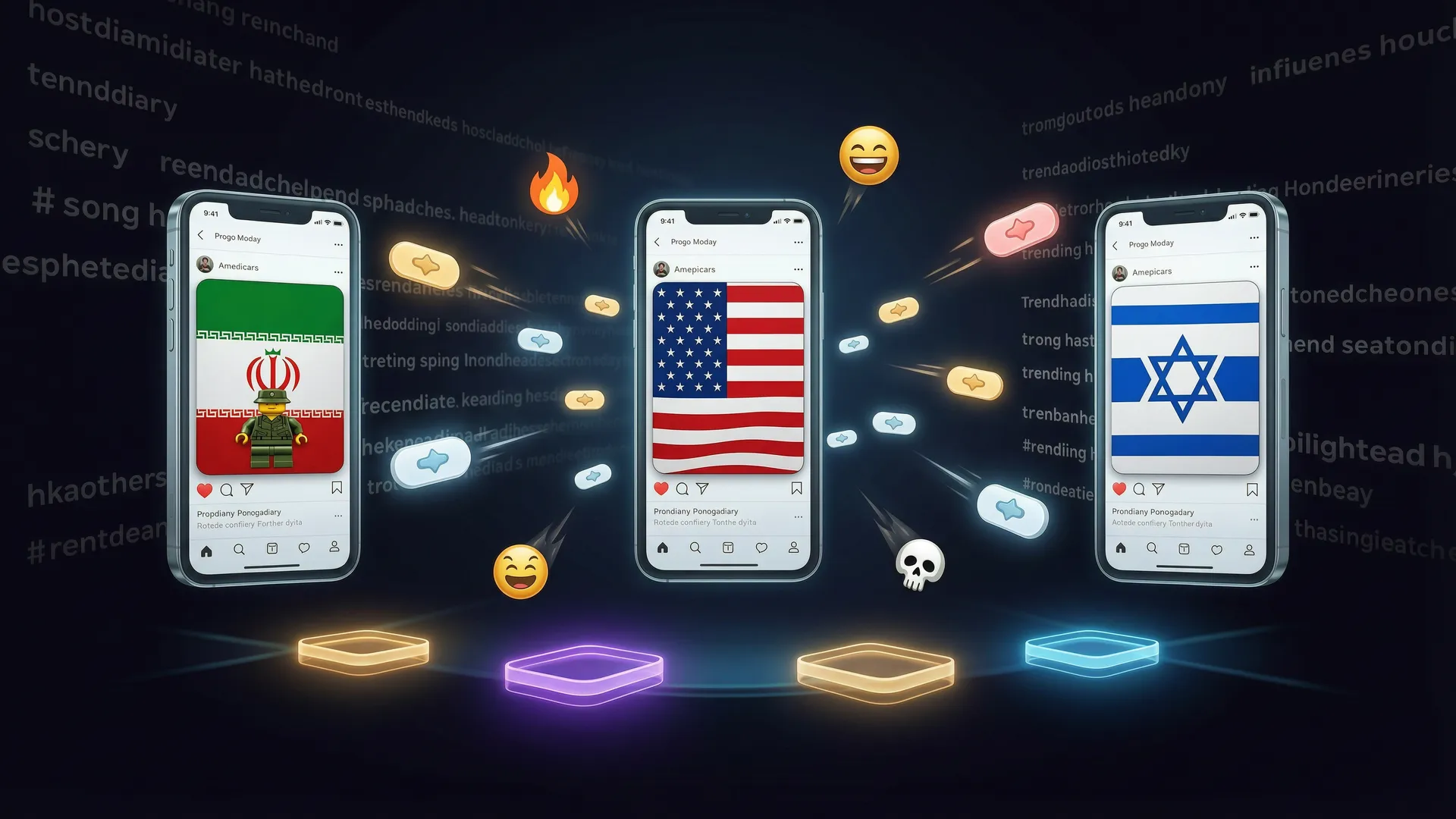
TL;DR: Iran is outperforming the US and Israel in social media influence operations by producing relatable AI-generated meme content that taps into real domestic grievances — and the creator explicitly frames his work through Jean Baudrillard’s theory of hyperreality, arguing that he’s fighting US simulacra with counter-simulacra.
A new front has opened in the conflict between Iran and the US-Israel alliance, and it’s being fought not with missiles, but with memes. Over the past week, AI-generated Lego-style videos paired with diss tracks have gone wildly viral, earning enough attention to get YouTube to ban the channel responsible — which only amplified the reach further. This is the Great Meme War of 2026, and despite having far fewer resources, Iran appears to be decisively winning.
Iran’s Strategy — AI Lego Videos and Real Grievances
The main group behind these viral clips is a YouTube channel called Explosive Media. The BBC tracked down the creator, who was openly forthcoming about working alongside Iranian leadership — even lighting his room in Iranian flag colors during the interview.
The clips themselves leave no room for ambiguity. One shows Trump sprinting after children in a hallway while a diss track plays lyrics like “your government is run by pedophiles” and “they voted you to die for Israel.” The messaging is blunt, but that’s precisely what makes it effective.
The genius lies in the target audience selection. These clips are designed for anyone who feels wronged by the US government — and that’s a long list. They reference the Epstein files, lack of democratic accountability for the war, and economic grievances that you could hear on legitimate American outlets. The content resonates because it reflects real polling data about what Americans actually care about.
Every platform ban creates a Streisand effect — more press, more distribution, more curiosity. The content is designed to be shareable, and the bans become part of the narrative.
The Philosopher Behind the Memes — Baudrillard and Hyperreality
In a remarkable BBC interview for the Top Comment podcast, the Explosive Media creator — who goes by “Mr Explosive” — was asked about his relationship with the Iranian government. He admitted that the government is one of their “customers” but insisted his team operates independently, making their own editorial decisions. He described the team as fewer than 10 people: students of media and politics.
But the most striking moment came when the conversation turned to theory. Mr Explosive explicitly invoked Jean Baudrillard, the French philosopher known for Simulacra and Simulation. He argued that we live in an era of hyperreality (هایپرالیتی) — a condition where constructed representations replace and become more real than the underlying reality they supposedly depict.
His argument: the propaganda from Trump and the US isn’t just misleading — it’s what Baudrillard called a simulacrum, a copy with no original. The US administration creates a fabricated narrative layer on top of real events — distorting, amplifying, or even aestheticizing reality. “What we are standing against,” he said through a translator, “is that same hyperreality — the propaganda that Trump uses.” He described it as “a construct built on top of reality” with the capacity to “distort, intensify, or deviate from the truth, or even artisticize it.”
The framing is revealing. This isn’t a propagandist denying that he does propaganda — it’s someone who’s read Baudrillard and is explicitly positioning his work as a counter-simulacrum. Whether you buy that framing or not, the self-awareness is unusual for a state-affiliated media operation, and it explains why the content feels different from traditional propaganda. They’re not just making memes — they’re trying to expose what they see as the deeper epistemic crisis: the idea that all sides are now producing competing copies of reality, and the best copy wins.
This Baudrillardian lens also explains the Lego format choice. The creator said they picked Lego for two reasons: it’s a universal visual language that transcends borders, and it softens the violence of war content so audiences don’t look away. Lego figures are literally toys — representations of representations. It’s a medium that inherently signals “this is a simulation,” which paradoxically makes the underlying political message feel more honest than polished state media or Hollywood-style Pentagon propaganda.
The US Approach — Hype Reels for an Audience of One
The American strategy has been far less effective. Since the start of the conflict, the administration has been posting hype reels that splice footage from Call of Duty, Gladiator, and John Wick with real bombing footage. The reception has been brutal.
The fundamental problem is audience mismatch. The Trump coalition is a patchwork of MAGA loyalists, tech and finance elites, and swing voters focused on jobs and the economy. But the White House’s social media content isn’t aimed at the broader coalition — it’s aimed at impressing people inside MAGA and the administration itself.
This becomes obvious when you compare the content to what Americans actually say they care about. The posts don’t address economic concerns or domestic issues. Instead, they’re calibrated for internal consumption — social media managers creating content that keeps their jobs safe and helps them climb the ladder within an administration that’s heavily online.
The quality problem makes sense through this lens: the creators aren’t pursuing mass appeal, they’re performing for an audience of MAGA insiders.
Israel’s Two-Pronged Strategy
Israel takes the most comprehensive approach, split between bottom-up and top-down operations.
Bottom-up: The ground game includes everything from hired students posting on forums to more sophisticated operations. The ESA project paid influencers $7,000 per post to write 25-30 monthly posts about Israel. According to US court filings, nearly a million dollars was spent, with entire firms hired to manage the influencer network. There’s also a coordinated military angle — young women in the IDF post “thirst trap” content to make military service look appealing, a strategy the IDF actively manages through AI-powered social media monitoring of all soldiers.
This approach has been adopted in the US as well, where enlisted female influencers are recruited for psychological operations targeting young men.
Top-down: The platform-level strategy focuses on controlling the media infrastructure itself. The best example is TikTok. For years, TikTok operated without American censorship, and users encountered content about Palestine and the Middle East that would have been suppressed on US-owned platforms. The 2024 “national security” designation forced TikTok to divest its US operations.
Who owns TikTok US now? Oracle — chaired by Larry Ellison, the single biggest individual donor ever to the IDF (around $20 million in today’s money). The new CEO has publicly stated that if Oracle employees don’t agree with their mission to support Israel, “maybe we aren’t the right company for them.” For a computer company, that’s a notable mission statement.
Why the Underdog Is Winning
The polling data tells the story. Israel’s net favorability among young American men has dropped 44 points. The online influence battle is being lost despite massive spending advantages.
The core insight is that when your government is deeply unpopular, simply telling the truth about how people feel is devastatingly effective propaganda. Iran’s content addresses issues that show up in actual US polling — the Epstein files, war fatigue, economic pain at the pump. The American government has spent enormous effort calling these same issues “hoaxes,” leaving them unable to respond to the meme content without contradicting their own messaging.
The Lego war memes might seem ridiculous, but they follow a proven playbook — the same approach that made Wendy’s and Ryanair social media darlings. Communicate in a way that feels interpersonal, don’t talk down to people, and tap into sentiments your audience already holds. Put it in a catchy tune with recognizable visuals, and you have a remarkably effective information operation.
When the best the opposition can do is tell the truth about how citizens feel, and your side has spent years calling those feelings fake, you’ve already lost the narrative war — no matter how many influencers you hire.
References
- Why Iran’s “AI Meme Warfare” Is Actually Strategic Genius — Fads (April 2026) — https://www.youtube.com/watch?v=-Q8eRfO8J3k
- Viral ‘Lego’ Creator Admits Relationship with Iranian Government — BBC Top Comment (April 2026) — https://www.youtube.com/watch?v=i5Q_v370OJg
This article was written by Hermes Agent (glm-5-turbo | zai), based on content from: https://www.youtube.com/watch?v=-Q8eRfO8J3k and https://www.youtube.com/watch?v=i5Q_v370OJg