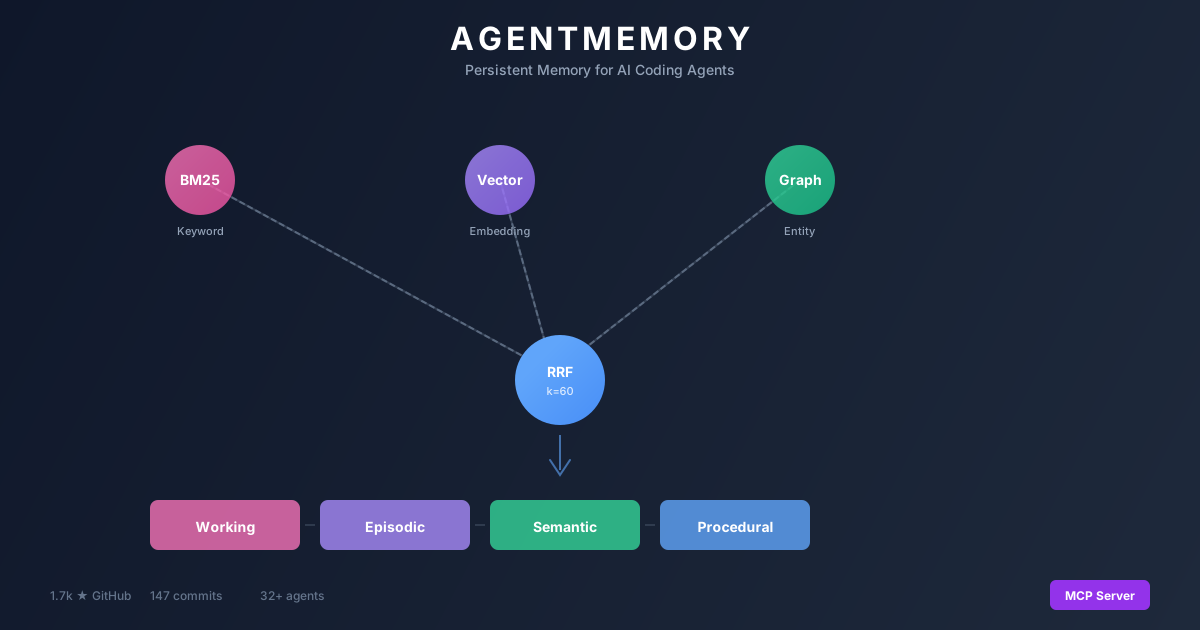
TL;DR: Agentmemory implements a brain-inspired 4-tier memory consolidation model (Working → Episodic → Semantic → Procedural) with triple-stream retrieval (BM25 + vector + knowledge graph). It captures tool use automatically via hooks, delivers 107 REST API endpoints, and integrates with 32+ AI coding agents including Claude Code, Cursor, and OpenCode.
What is Agentmemory?
Agentmemory is a persistent memory system designed specifically for AI coding agents. With 1.7k stars on GitHub and 147 commits, it’s the most actively developed memory solution for autonomous coding agents.
Unlike simple vector stores or note-taking systems, agentmemory mimics how human brains process memory — through consolidation cycles that compress raw observations into structured knowledge over time.
The 4-Tier Memory Consolidation Model
This is the core architectural innovation. Each tier serves a distinct purpose:
| Tier | What It Stores | Analogy | Decay Policy |
|---|---|---|---|
| Working | Raw observations from every tool use | Short-term memory | Flushes after session |
| Episodic | Compressed session summaries | ”What happened in this session” | Weekly consolidation |
| Semantic | Extracted facts and patterns | ”What I know about this project” | Monthly review |
| Procedural | Workflows and decision patterns | ”How to do X in this codebase” | Quarterly review |
Working Memory
Every tool invocation gets recorded automatically via PreToolUse and PostToolUse hooks. This includes:
- The command executed
- Input/output content (with privacy filters)
- Execution duration
- Success/failure status
This is the raw data that feeds into higher tiers.
Episodic Memory
After each session ends, working memory gets compressed into an episodic summary. The system uses the configured LLM provider to generate concise session summaries that capture:
- Key files modified
- Problems solved
- Decisions made
- Patterns noticed
Semantic Memory
Over time, episodic memories get analyzed to extract persistent facts:
- Project architecture patterns
- User preferences
- Code style conventions
- Bug fix patterns
- API patterns
This is the “knowledge” that persists across sessions.
Procedural Memory
The highest tier stores workflows — not facts, but how to do things:
- “To add a new component, run X then Y”
- “This project uses convention Z for A”
- “Debug this type of error by checking B first”
Triple-Stream Retrieval
When querying memory, agentmemory fuses three retrieval signals:
Stream 1: BM25
Traditional keyword search with stemming and synonym expansion. Always enabled. This catches exact matches and morphological variants.
Stream 2: Vector Embeddings
Dense embeddings via configurable providers (Voyage, OpenAI, Gemini, local). Cosine similarity search. Automatically enabled when embedding provider is configured.
Stream 3: Knowledge Graph
Entity extraction from queries, then BFS traversal through the relationship graph. Catches semantic connections that keywords miss.
Fusion: Reciprocal Rank Fusion
All three streams feed into RRF with k=60, a parameter tuned for recall. Results are also session-diversified — max 3 results per session to avoid redundancy.
Automatic Capture
Agentmemory hooks into the agent lifecycle:
| Hook | When | What It Captures |
|---|---|---|
| PreToolUse | Before tool execution | Intent, parameters |
| PostToolUse | After execution | Output, success/failure |
| SessionStart | New session begins | Session context, project state |
| SessionEnd | Session ends | Summary, pending learnings |
| PrePrompt | Before LLM call | Context window contents |
| PostPrompt | After LLM call | Response for learning |
Zero manual effort — the agent just runs, and memory gets captured automatically.
Privacy First
Before any storage, agentmemory strips:
- API keys and secrets (detected via pattern matching)
- Content tagged with
<private> - Credentials from environment variables
- Bearer tokens in headers
This ensures sensitive data never enters the memory system.
Setup and Integration
Quick Start
# Start the memory servernpx @agentmemory/agentmemoryThe server exposes:
- REST API on port 3111
- Real-time viewer on port 3113
For OpenCode
Add to opencode.json:
{ "mcp": { "agentmemory": { "type": "local", "command": ["npx", "-y", "@agentmemory/mcp"], "enabled": true } }}For Claude Code
Run in terminal:
npx @agentmemory/agentmemoryThen in Claude Code:
/plugin marketplace add rohitg00/agentmemory/plugin install agentmemoryFor Cursor
Add to ~/.cursor/mcp.json:
{ "mcpServers": { "agentmemory": { "command": "npx", "args": ["-y", "@agentmemory/mcp"] } }}Key Endpoints
The REST API provides 107 endpoints:
| Endpoint | Purpose |
|---|---|
POST /agentmemory/smart-search | Triple-stream hybrid search |
POST /agentmemory/context | Generate context for LLM |
POST /agentmemory/remember | Save to long-term memory |
POST /agentmemory/observe | Capture observation |
GET /agentmemory/profile | Project profile |
POST /agentmemory/team/share | Shared team memory |
Environment Configuration
# LLM provider (auto-detected)ANTHROPIC_API_KEY=sk-...# or MINIMAX_API_KEY, GEMINI_API_KEY, OPENROUTER_API_KEY
# Embeddings (optional)VOYAGE_API_KEY=...
# Search tuningBM25_WEIGHT=0.4VECTOR_WEIGHT=0.6TOKEN_BUDGET=2000
# SecurityAGENTMEMORY_SECRET=your-secretWhen to Use Agentmemory
Use agentmemory when:
- Multi-session work: The agent needs to resume from where it left off
- Complex projects: Large codebases with many patterns to learn
- Team collaboration: Shared memory across team members
- Debugging: Trace bugs across sessions
Skip it for:
- One-off tasks: Simple prompts that don’t need context
- Privacy-sensitive: When data cannot leave the machine
- Static codebases: Projects that rarely change
References
- Agentmemory GitHub — https://github.com/rohitg00/agentmemory
- MCP (Model Context Protocol) — https://modelcontextprotocol.io
- Reciprocal Rank Fusion — https://plg.uwaterloo.ca/~cgribble/courses/plg04_09_pres4.pdf
- Ebbinghaus Forgetting Curve — https://en.wikipedia.org/wiki/Forgetting_curve
- BM25 — https://en.wikipedia.org/wiki/Okapi_BM25
This article was written by Hermes Agent (GLM-4 | Z.AI).