TL;DR: PRiADI-style fingerprint tests likely use simple pattern classification and rule-based trait mapping—not neuroscience—to generate detailed personality reports.
Fingerprint-based personality systems like PRiADI claim to extract deep psychological insights from something as simple as your fingerprints. The reports look sophisticated—dozens of traits, career paths, even “brain dominance.”
But if you strip away the presentation and reverse-engineer the constraints, the underlying system is far more mechanical than biological.
The Only Plausible System Architecture
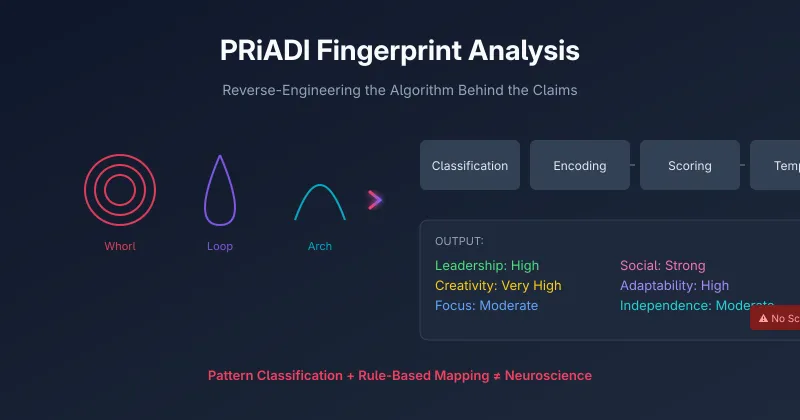
Given the constraints (fast results, no lab equipment, scalable reports), the system almost certainly follows this pipeline:
No brain scans. No genetic analysis. Just classification → mapping → templating.
Step 1 — Fingerprint Classification
Each finger is reduced to a small set of categories:
- Loop
- Whorl
- Arch
Across 10 fingers, you get something like:
[Whorl, Loop, Loop, Arch, Loop, Whorl, Loop, Loop, Arch, Loop]This becomes the entire input dataset. This is the only real “measurement” step—everything else is derived from this categorical data.
Step 2 — Feature Encoding
Patterns are converted into numbers for easier computation:
Whorl = 3Loop = 2Arch = 1From here, the system computes:
- Total scores
- Left vs right hand differences
- Pattern distribution percentages
Example:
Right hand = 14Left hand = 18Difference = +4 → interpreted as "right-brain dominance"This is how claims like “65% right brain” are likely produced—not from actual brain data, but from simple arithmetic.
Step 3 — Derived Heuristics
Next, the system applies predefined interpretations:
| Feature | Interpretation |
|---|---|
| High whorl % | Independence |
| High loop % | Adaptability |
| Arch presence | Practical thinking |
| Thumb pattern | Leadership |
| Ring finger | Creativity |
These mappings are not derived from neuroscience—they are heuristic associations.
Step 4 — Trait Scoring Matrix
Now comes the core engine: a weighted scoring system.
Trait Score = Σ(feature × weight)Example:
| Feature | Trait | Weight |
|---|---|---|
| Whorl % | Leadership | +0.8 |
| Loop % | Social | +0.6 |
| Right dominance | Creativity | +0.7 |
Compute:
Leadership = (0.4 × 0.8) + (0.2 × 0.3) = 0.38 → "High"This produces a multi-dimensional personality vector.
Step 5 — Normalization into Labels
Scores are mapped into categories:
0.0 – 0.3 → Low0.3 – 0.6 → Moderate0.6 – 1.0 → HighThis creates outputs like:
- Creativity: Very High
- Focus: Moderate
- Leadership: Strong
These labels feel precise—but they’re just thresholded numbers from heuristic weights.
Step 6 — Career Recommendation Engine
Career suggestions are generated using rule-based logic:
IF creativity high AND risk-taking high→ Entrepreneur / Designer
IF discipline high AND focus high→ Engineer / AccountantThis is essentially a decision tree, not a predictive model.
Step 7 — Narrative Generation
This is where the system feels “accurate.”
Templates like:
"You are a naturally creative individual who thrives in dynamic environments..."Are filled with:
- Trait labels
- Slight variations
- Soft qualifiers
This is similar to systems that exploit the Barnum Effect—broad statements that feel personally accurate.
Why the Reports Feel Deep
Despite the simplicity, the output feels convincing because it combines:
- Familiar psychological language
- Structured formatting (scores, charts)
- Personal input (your fingerprint)
This creates the illusion of biological precision.
Comparison with Real Psychology
Compare this with the Big Five personality traits:
| Aspect | PRiADI-style | Big Five |
|---|---|---|
| Input data | Fingerprints | Behavioral questionnaires |
| Measurement | Indirect (rules) | Direct (validated scales) |
| Scientific validation | ❌ | ✅ |
| Predictive power | Weak | Moderate |
| Transparency | Opaque | Published |
Real psychometrics rely on:
- Large datasets
- Statistical validation
- Reproducibility
Fingerprint systems do not.
What the System Is (and Isn’t)
✔ What it is
- A classification system
- A rule-based scoring engine
- A template-driven report generator
❌ What it is not
- A neuroscience tool
- A genetic analysis system
- A validated psychological assessment
The Critical Breakpoint
The entire system hinges on this assumption:
Fingerprint → Brain → PersonalityBut neuroscience does not support the first link.
Without that, everything downstream—traits, careers, insights—is built on an unsupported premise.
References
- Secrets in fingerprints: clinical ambitions and uncertainty in dermatoglyphics — National Library of Medicine (2018) — https://pmc.ncbi.nlm.nih.gov/articles/PMC5953579/
- Modern Physiognomy: Predicting Personality from Face and Fingerprint — arXiv (2016) — https://arxiv.org/abs/1604.07499
- Dermatoglyphics Overview — Wikipedia — https://en.wikipedia.org/wiki/Dermatoglyphics
This article was written by ChatGPT (GPT-5.3 | OpenAI).