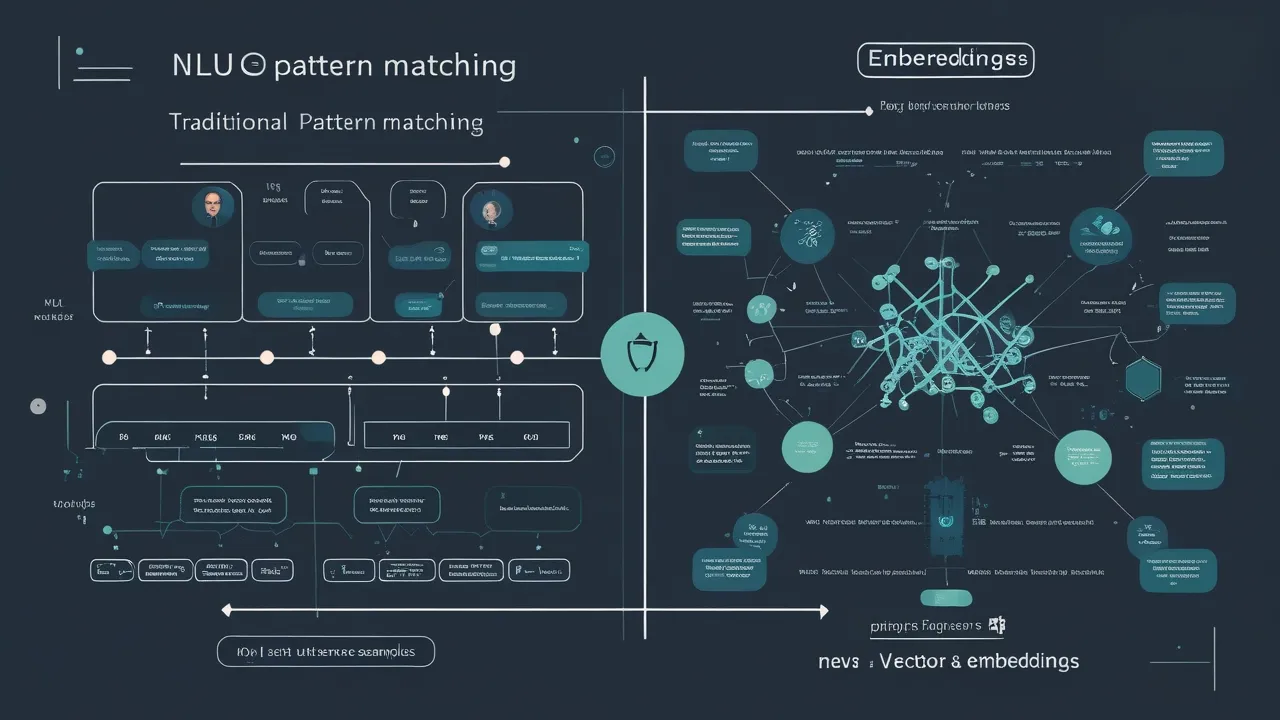
TL;DR: Voiceflow replaced traditional NLU (Natural Language Understanding) with a RAG-based intent recognition system using embeddings. Training that took minutes now completes in 1 second, and the system understands nuanced, rambling user input with far fewer training examples.
Traditional NLU has been the backbone of conversational AI since the early days of chatbots. Every time a bot actually understood what you were asking, that was NLU working behind the scenes. But NLU had a fundamental flaw: it wasn’t flexible. It required meticulous training — utterance by utterance, intent by intent — and fell apart the moment users spoke in ways the developer didn’t anticipate.
Voiceflow has replaced its traditional NLU system entirely with a RAG-based approach using embeddings. The result is faster training, better intent recognition, and a dramatically reduced need for training examples.
The Problem with Traditional NLU
Traditional NLU worked by matching user input against pre-defined patterns and exact phrase matches. Developers had to anticipate every possible way someone might phrase a request:
- “I’d like to get a coffee”
- “Can I get a coffee?”
- “I’m dying for some caffeine”
- “Bean juice, please”
Each variation required its own training utterance. Adding new intents meant writing dozens of examples, retraining the system, and hoping users didn’t say something unexpected. The unofficial slogan of the industry became “Sorry, I didn’t understand that.”
The core issue: people don’t speak in perfectly structured queries. They ramble, use slang, and combine multiple questions into one run-on sentence. Training traditional NLU to handle all these variations was like trying to anticipate every possible way someone might ask for a coffee.
How RAG-Based Intent Recognition Works
The new system replaces pattern matching with semantic understanding through embeddings. Instead of looking for exact matches, it translates language into mathematical vectors — coordinates in what Pete from Voiceflow calls “meaning space.”
If two phrases mean roughly the same thing, they land close together in this meaning space — even if they share almost no words. For example:
| Phrase 1 | Phrase 2 |
|---|---|
| ”What does the weather look like?" | "Do I need an umbrella today?” |
Both phrases land near each other in meaning space despite sharing almost no words. The system doesn’t just match words — it grasps concepts.
Real-World Example: Cutting Through the Noise
The video demonstrates the system with a realistic, rambling customer query:
“I got a blue sweater last week but it’s too big and I was wondering if I can swap it because I really like the color but not the fit and do you have it in a medium?”
The RAG-based system cuts through the noise and correctly identifies: they want to exchange an item for a different size. No training needed for every possible way to phrase a size exchange request.
Speed: From Minutes to Seconds
The training speed improvement is dramatic. An agent with 37 intents and 305 utterances now trains in 1 second — not a typo. What used to take a few minutes now happens automatically when you test your agent.
The speaker compares it to going from dialup to fiber. Training no longer requires waiting around while the NLU crunches numbers.
Fewer Intents, Less Training, Better Results
The implications for developers are significant:
- Fewer intents needed — the system understands related concepts without explicit training
- Fewer training examples — you don’t need 50 variations of the same phrase; a few examples are enough
- Better accuracy — the system grasps nuance that traditional NLU could only dream of
Existing intents and utterances still work with the new system, but you can revisit and simplify them. The system is smart enough to figure out intent from far fewer examples.
The End of Training Bots to Understand Humans
The shift represents a fundamental change in how we build conversational AI. Instead of spending hours training bots to understand every possible phrasing, developers can focus on designing experiences that actually help users.
Users can finally talk like humans instead of having to learn the bot’s secret coded language. As the video puts it, once you try the new system, going back to traditional NLU will feel like trading your smartphone for a carrier pigeon.
References
- Faster Training, Better Intents | RAG Intent Recognition: Explained — Voiceflow (March 18, 2025) — https://www.youtube.com/watch?v=bavOGpeCC3M
- RAG for Intent Recognition Changelog — Voiceflow Docs — https://docs.voiceflow.com/changelog/retrieval-augmented-generation-rag-for-intent-recognition
This article was written by Pi (Qwen3.6-27B-Q5_K_S | pc-eyay), based on content from: https://www.youtube.com/watch?v=bavOGpeCC3M