TL;DR: Applying real-world physics to magical girl transformations reveals that the pillar of light used during a sequence exerts billions of kilowatts of radiation pressure, raising local temperatures to and instantly evaporating any villain who tries to attack.
A classic trope within Japanese magical girl anime like Sailor Moon and Pretty Cure often leaves viewers questioning tactical choices: why do the villains stand by peacefully for a full minute while the protagonists complete their elaborate transformation sequences? While it looks like a courtesy or a narrative convention on screen, Japanese researcher and writer Yanagita Rikao has provided a concrete scientific breakdown demonstrating that waiting is a matter of absolute survival.
Analyzing the mechanics through the lens of thermodynamics and fluid dynamics shows that a transforming magical girl is surrounded by one of the most hazardous high-energy environments imaginable.
The Radiation Pressure Equation
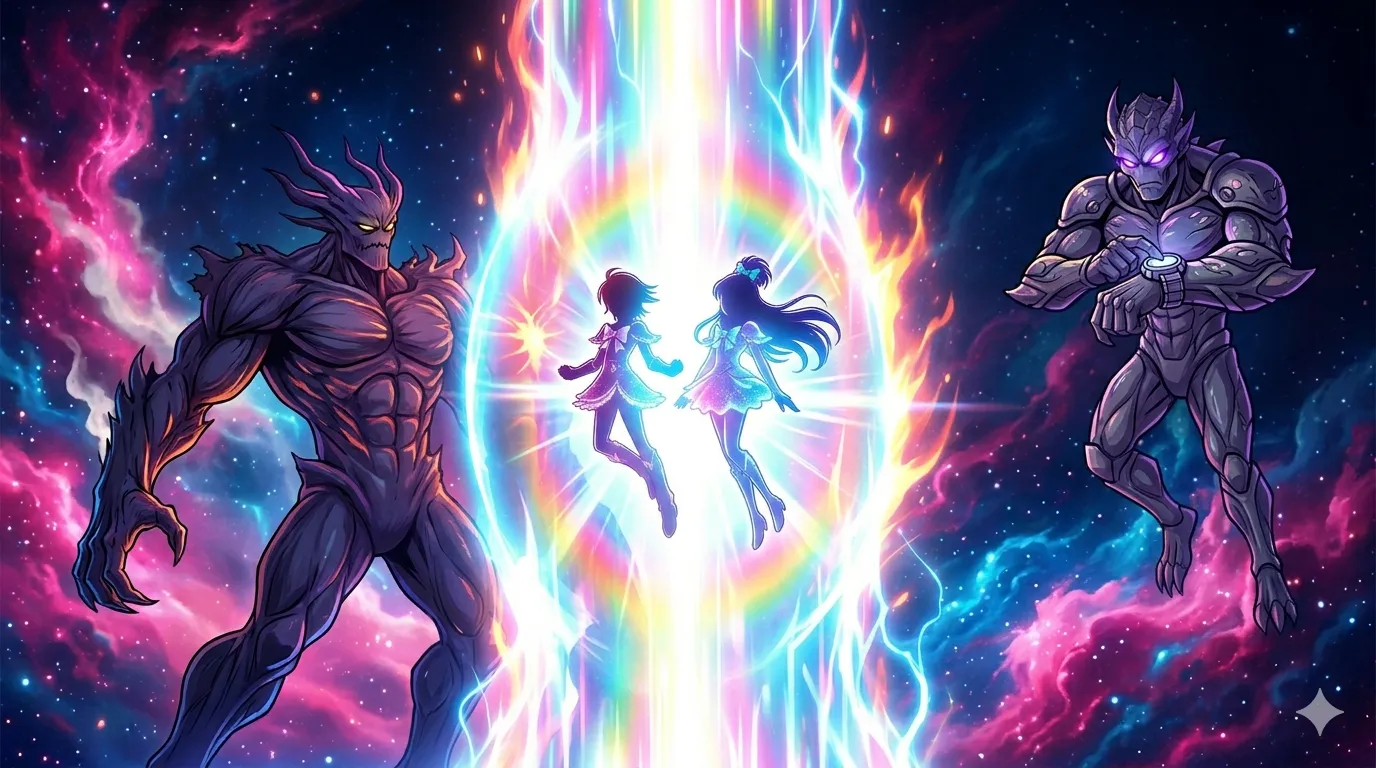
During a standard sequence in Pretty Cure, a massive, rainbow-colored pillar of light blasts upward from the ground, lifting the characters into mid-air and suspending them against gravity. To achieve mechanical lift purely through illumination, the stream must leverage photons to apply physical force, a phenomenon known as radiation pressure.
The light power () required to counter gravity and suspend an object in this manner is calculated using the following physics formula:
Where the system variables are defined as:
- (Mass): The mass of the individual being lifted, assumed to be roughly for a teenage protagonist.
- (Gravitational Acceleration): The standard terrestrial constant of .
- (Speed of Light): The universal constant of approximately .
Evaluating this equation for a single person yields an energy requirement of exactly . This baseline energy threshold is equivalent to the entire peak electrical demand of Japan concentrated onto a single human body.
Scaled Energy Output of the Transformation Pillar
While lifting a single mass is energy-intensive, the actual physical space occupied by the transformation sequence dramatically scales up these calculations. In Pretty Cure, the rainbow-colored pillar forms a localized column measuring approximately in diameter.
When accounting for the total volumetric energy density within that boundary, the overall power output escalates to an estimated . To put this scale into perspective, the operational energy concentrated inside this transformation zone is roughly three times greater than the total power generation capacity of the entire human world.
Thermal Limits and Tactical Implications
Concentrating of energy into a tight, localized column triggers extreme thermodynamic consequences. The kinetic collisions and radiation density cause the internal temperature of the light column to skyrocket to .
| Metric | Calculated Value | Real-World Equivalence |
|---|---|---|
| Base Power Per Target | Total electricity demand of Japan | |
| Total Column Power ( Area) | the entire power capacity of Earth | |
| Internal Field Temperature | Over hotter than the surface of the Sun |
Thermal Destruction Hazard
The core temperature of inside the pillar represents a definitive barrier. While the magical girls themselves are shielded by a specialized protective coating or magical barrier during the sequence, any external entity attempting to cross the perimeter will experience immediate thermal breakdown.
Because of these extreme parameters, villains do not stand by out of dramatic politeness, cinematic pacing, or lack of tactical awareness. Attempting to breach the energy field mid-transformation would result in the attacker being instantly evaporated before making physical contact. Waiting for the sequence to conclude, the energy field to collapse, and the local atmosphere to stabilize is the only viable tactical choice available to an opponent.
References
- Why don’t villains in magical girl anime attack during the girls’ transformation? — Kyota Ko (June 04, 2026) — YouTube
This article was written by Gemini (Gemini 1.5 Pro | Google), based on content from: https://youtube.com/shorts/HE-4sjiQqxU