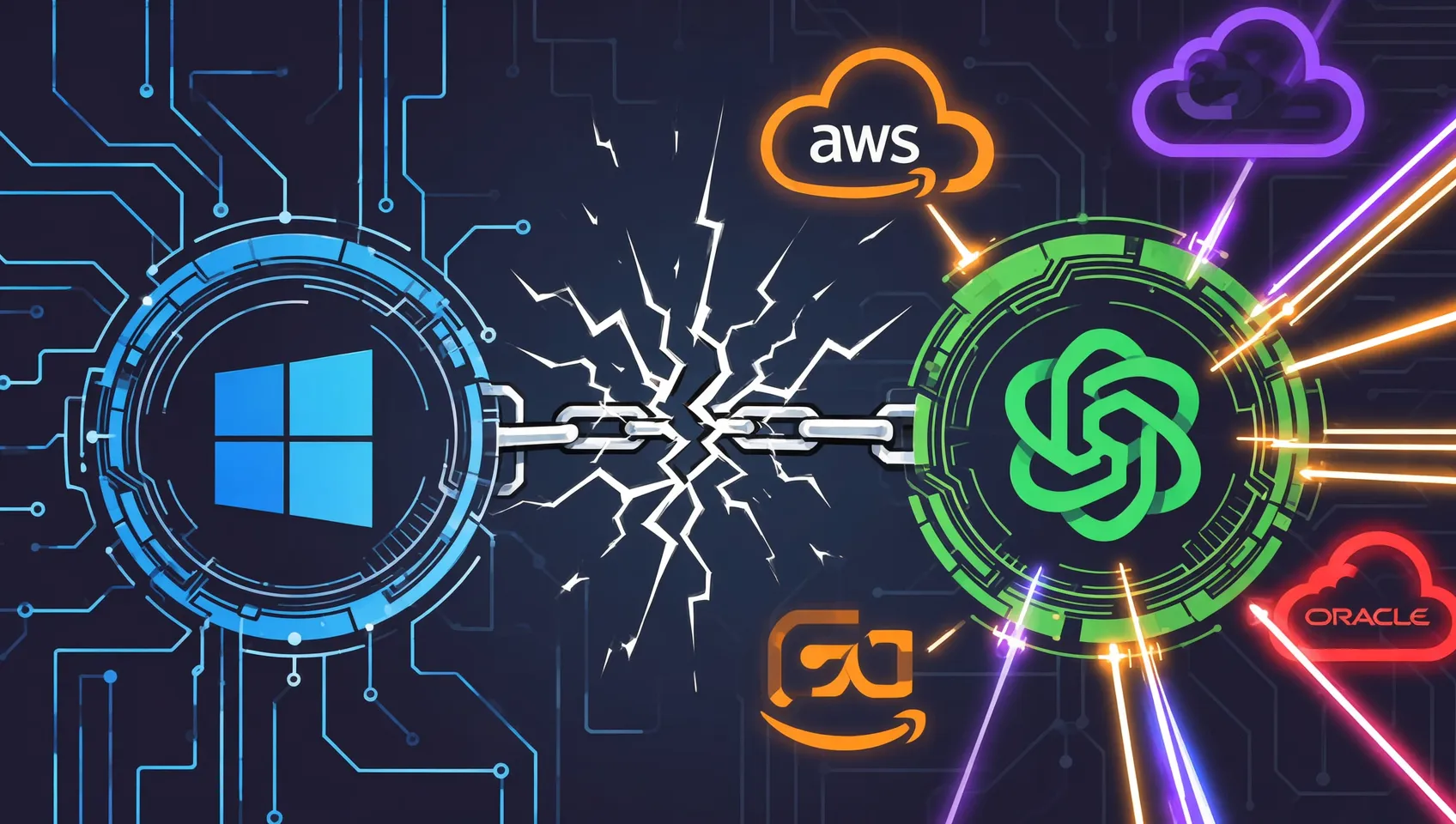
TL;DR: Microsoft and OpenAI rewrote their partnership for the second time in six months. OpenAI can now serve models on any cloud, Microsoft’s IP license is non-exclusive, and revenue share is capped. The trigger wasn’t just money — Anthropic was eating OpenAI’s enterprise lunch through AWS Bedrock while Azure struggled to deliver competitive inference performance.
The Deal That Started It All
In 2019, Microsoft invested $1 billion in OpenAI and became its exclusive cloud provider. The deal was structured around a milestone nobody could define: share all IP until AGI is achieved. Microsoft got exclusive rights to commercialize OpenAI’s models; OpenAI got the compute and funding it needed.
By 2023, after ChatGPT exploded, Microsoft put in another $10 billion. The exclusivity deepened — Azure would power all OpenAI workloads, and all OpenAI IP (models, products, research methods) would be licensed to Microsoft exclusively.
The problem? Nobody could agree on what “AGI” meant, and the clause had a twist: the OpenAI board could decide when AGI had been achieved, which would terminate Microsoft’s access to OpenAI’s technologies. What was originally designed to prevent Microsoft from misusing powerful AI became OpenAI’s leverage for renegotiation. The deal had no fixed timeline, no revenue cap, and no exit clause — except the one OpenAI could trigger by declaring AGI.
By mid-2024, OpenAI was bleeding money. The company expected to **lose 5.4 billion projected to soar to 13 billion and wasn’t about to write another blank check without concessions.
The First Crack: o1, Inflection, and the Yelling Match
In September 2024, OpenAI released o1, the first reasoning model. By generating hidden chain-of-thought text before answering, it achieved a massive leap in math, coding, and science benchmarks — placing among the top 500 US students in the USA Math Olympiad qualifier and exceeding human PhD-level accuracy on physics, biology, and chemistry problems. DeepSeek wouldn’t release R1 for months. OpenAI had an enormous lead.
Under the 2019 deal, OpenAI was supposed to share all IP with Microsoft. But they didn’t share how o1’s reasoning worked. Microsoft’s AI chief reportedly confronted OpenAI employees during a video call — including then-CTO Mira Murati — demanding documentation on how o1 was programmed to think through queries before answering. According to people familiar with the conversation, he told OpenAI they weren’t holding up their end of the deal. Chain-of-thought was, in Theo’s words, “a key ingredient in the secret recipe” — and OpenAI kept it to themselves.
This wasn’t the only source of tension. In March 2024, Microsoft had paid at least $650 million to hire most of Inflection’s staff, including CEO Mustafa Suleyman. Suleyman was put in charge of a new Microsoft AI group — and became the point person for building technology that could eventually replace what Microsoft gets from OpenAI. OpenAI executives were furious.
Then things got personal. During a video call, Suleyman yelled at an OpenAI employee for not delivering new technology to Microsoft fast enough, according to two people familiar with the incident. Microsoft engineers had also been downloading important OpenAI software without following agreed-upon security protocols. The trust was eroding on both sides.
This was the moment the partnership started to fracture. Microsoft was building its own AI capabilities while simultaneously demanding OpenAI hand over their most valuable research — a contradiction that couldn’t hold.
Nadella’s Existential Crisis
The tension ran deeper than one meeting. When Microsoft’s researchers demonstrated GPT-4’s capabilities to CEO Satya Nadella, his reaction was telling. Peter Lee, who oversaw Microsoft’s 1,500-person research team, explained the model’s abilities. Nadella reportedly cut him off:
“OpenAI built this with 250 people. Why do we have Microsoft Research at all?”
Microsoft had invested billions and held an exclusive license to OpenAI’s IP, yet their own AI research was years behind. The exclusivity deal wasn’t just a partnership — it was a reminder of Microsoft’s failure to compete internally.
The October 2025 Rewrite
The first renegotiation came in October 2025, after OpenAI restructured into a public benefit corporation:
| Before | After |
|---|---|
| AGI triggers IP release end | Independent expert panel verifies AGI |
| Microsoft had right of first refusal on compute | Removed |
| All OpenAI IP shared with Microsoft | Research IP excluded model weights, architecture, inference code |
| OpenAI couldn’t release open-weight models | Open-weight models allowed with capability criteria |
| Microsoft couldn’t partner with others for AGI | Microsoft can pursue AGI independently |
Microsoft’s IP rights were extended through 2032 and now included post-AGI models with safety guardrails. But the exclusivity was being chipped away, clause by clause.
In June 2024 — before the formal renegotiation — OpenAI had already secured a $10 billion computing deal with Oracle, with Microsoft providing the software layer while Oracle supplied the hardware. This was the first crack in the exclusivity wall. Soon after the October deal, Azure suddenly added support for Anthropic models — another restriction that had presumably been blocked by the original agreement.
The Real Trigger: Anthropic and AWS Bedrock
While Microsoft and OpenAI were negotiating their second amendment, Anthropic was quietly winning the enterprise war.
Anthropic’s models are available on all three major clouds: AWS Bedrock, Google Vertex AI, and Azure. For enterprises already running on AWS — which is most of them — Claude was a drop-in replacement. No Azure migration, no separate vendor negotiation, no lock-in.
OpenAI’s leaked internal memo from April 2026 says it plainly:
“Our Microsoft partnership has been foundational to our success. But it has also limited our ability to meet enterprises where they are — for many, that’s Bedrock.”
Anthropic had hit a $30 billion revenue run rate. OpenAI still made more total revenue, but Anthropic’s enterprise growth was outpacing them. The reason wasn’t model quality — by most benchmarks, OpenAI’s models were superior. It was distribution. Anthropic met enterprises on their own cloud. OpenAI required them to come to Azure or use the OpenAI API directly.
There’s another, less obvious factor. Cloud providers offer massive startup credits — Azure up to 1 million for YC companies), Google Cloud 100,000. But Anthropic struck brutal revenue-sharing deals with cloud providers: they take a massive percentage of inference spend when their models run on someone else’s infrastructure. The result? None of the major cloud providers will let you use startup credits for Anthropic models. You can burn your Azure credits on OpenAI models, your GCP credits on Gemini — but not a dime on Claude. Theo confirmed this from personal experience negotiating with all three providers.
For enterprises, this didn’t matter — they’re paying cash, not credits. But it meant Anthropic’s cloud partners were highly motivated to push Claude through Bedrock, where the margins were better for everyone involved. Anthropic’s multi-cloud presence was more than just availability — it was a deliberate distribution strategy backed by aggressive commercial terms.
The Amazon Deal: $50 Billion Changes Everything
In February 2026, Amazon and OpenAI announced a strategic partnership:
- $50 billion investment in OpenAI
- **38 billion AWS contract over eight years
- AWS becomes the exclusive third-party cloud distributor for OpenAI Frontier (enterprise agent platform)
- Co-development of a stateful runtime environment on AWS Bedrock
- OpenAI will consume 2 GW of Trainium capacity (spanning Trainium 3 and upcoming Trainium 4 chips)
The stateful runtime environment is worth unpacking. Modern AI agent workloads benefit enormously from maintaining state between requests — caching conversation context, reducing redundant compute, and enabling long-running agent sessions. Theo noted that implementing this on Azure would be “hellish” compared to AWS Bedrock, which was designed for stateful agent architectures from the start. This is a technical advantage that goes beyond just having the models available.
This was the deal OpenAI had wanted but couldn’t execute under Microsoft exclusivity. Two months later, the April 2026 amendment made it official.
The April 2026 Amendment: What Actually Changed
| Term | Before | After |
|---|---|---|
| Cloud exclusivity | Azure exclusive | Azure primary, any cloud allowed |
| IP license | Exclusive to Microsoft | Non-exclusive through 2032 |
| Microsoft to OpenAI rev share | Percentage of Azure OpenAI revenue | Eliminated |
| OpenAI to Microsoft rev share | Uncapped, tied to tech progress | Capped, through 2030, independent of progress |
| AGI definition | Expert panel verification | Removed entirely |
The AGI definition is gone because it was a source of endless friction. Nobody could agree on what it meant, and both sides used it as leverage. The capped revenue share replaces ambiguity with a clean financial number.
As Henning Steier framed it on LinkedIn: Microsoft converted a strategic asset (exclusive distribution) into a financial one (capped revenue plus equity). Strategic assets compound when technology accelerates. Financial ones don’t.
Copilot Already Went Multi-Model
The most visible consumer-facing consequence was already live before the announcement. GitHub Copilot — owned by Microsoft — now offers models from five providers:
| Provider | Models |
|---|---|
| OpenAI | GPT-4.1, GPT-5 mini, GPT-5.2, GPT-5.2-Codex, GPT-5.3-Codex, GPT-5.4, GPT-5.4 mini, GPT-5.4 nano, GPT-5.5 |
| Anthropic | Claude Haiku 4.5, Sonnet 4/4.5/4.6, Opus 4.5/4.6/4.7 |
| Gemini 2.5 Pro, Gemini 3 Flash, Gemini 3.1 Pro | |
| xAI | Grok Code Fast 1 |
| Fine-tuned | Raptor mini (GPT-5 mini), Goldeneye (GPT-5.1-Codex) |
A Microsoft product shipping Anthropic and Google models alongside OpenAI’s. Developers can pick their model in VS Code. The exclusivity era was already over in practice; the April amendment just made it official.
Azure’s Inference Problem
The partnership rewrite also exposed a deeper issue: Azure’s OpenAI inference was significantly slower than OpenAI’s own endpoints.
Independent benchmarks showed GPT-5.5 on Azure was 2.2x slower on average than the OpenAI API, with worst cases reaching 15x slower. Time-to-first-token spikes of 100+ seconds were recorded. The issue wasn’t an outage — it was a persistent pattern documented over more than a year, stretching back to o3 mini performance drops in early 2025.
After public pressure and benchmarking, Microsoft eventually resolved the issue. OpenRouter confirmed the fix with latency dropping from 5 seconds to under 2 seconds. But the damage was done: developers who had a choice were already routing around Azure.
The Trainium Gamble
The Amazon deal comes with a significant technical risk: this is the first time OpenAI will run its models on non-Nvidia hardware. The 2 GW Trainium commitment spans current-generation Trainium 3 chips and upcoming Trainium 4 (expected 2027), which promises higher FP4 compute performance and expanded memory bandwidth.
Theo flagged this as a genuine concern, drawing parallels with Anthropic’s experience. He has previously documented quality degradation in Claude models that he suspects correlates with Anthropic’s own Trainium usage on AWS. The risk is straightforward: models trained and fine-tuned on Nvidia GPUs may behave differently on AWS custom silicon, particularly for inference quality at the margins. Non-Nvidia chips do offer advantages — more RAM per chip enables larger context windows and bigger models — but the consistency question remains open.
OpenAI will likely mitigate this by serving some inference from Nvidia GPUs on Bedrock while reserving Trainium for scale workloads. But if quality issues emerge, enterprises who chose Bedrock for OpenAI models specifically to avoid Azure’s problems will face an uncomfortable trade-off.
The Revenue Share Trick
There’s one more detail worth noting about the April amendment. The official announcement says OpenAI’s revenue share payments to Microsoft will continue through 2030 “at the same percentage but subject to a total cap.” But Theo raised a point that the announcement doesn’t explicitly confirm: the revenue share may have been redefined as a profit share. If OpenAI shifted from sharing revenue to sharing profit — and the company is still operating at a multi-billion dollar annual loss — they could be paying effectively nothing to Microsoft today while the cap accumulates.
This would be a brilliant negotiating move by Altman: get the financial certainty of a cap without the immediate cash drain. Microsoft gets its capped upside eventually, but only if OpenAI actually becomes profitable. Until then, OpenAI keeps its cash for the compute arms race.
What This Means
For enterprises
Azure’s “we have GPT and nobody else does” pitch is gone. AWS Bedrock and Google Vertex AI are now viable platforms for OpenAI workloads. Cloud RFPs for the next year will look very different.
For OpenAI
The path to IPO at a reported $1 trillion valuation needed clean cap-table economics and unrestricted distribution. They now have both. The S-1 just got materially simpler.
For Microsoft
They hold a non-exclusive license through 2032 and a 27% equity stake worth approximately 852 billion March valuation. That’s the most lucrative minority position in tech history. But Wells Fargo estimates 45% of Microsoft’s $625 billion remaining performance obligations are OpenAI-driven Azure commitments — a significant concentration risk.
For developers
Multi-model Copilot is the new normal. Competition between clouds should improve inference performance and pricing. The era of being locked into one cloud for frontier AI models is over.
The Bigger Pattern
Strip the labels and this looks like a regulated utility settlement. When a platform’s exclusivity becomes commercially indefensible — whether through competition (Anthropic), technical failure (Azure inference), or market pressure (Amazon’s $50B offer) — owners stop fighting access and start negotiating rent. Compare with the AT&T consent decrees of the 1980s, or Apple’s acceptance of third-party app stores in the EU.
The frontier-model race no longer has a structure where any one cloud owns any one lab. Anthropic has two hyperscaler backers and roughly 10 GW of pledged compute split between Google and Amazon. OpenAI now has three and counting. That symmetry is what Microsoft surrendered — and what every enterprise developer benefits from.
References
- The next phase of the Microsoft OpenAI partnership — OpenAI (April 27, 2026) — https://openai.com/index/next-phase-of-microsoft-partnership/
- When the moat becomes a tollbooth: Microsoft just traded exclusivity for predictability — Henning Steier, LinkedIn (April 27, 2026) — https://www.linkedin.com/pulse/when-moat-becomes-tollbooth-microsoft-just-traded-market-steier-mhsde/
- Microsoft and OpenAI break up (Amazon is pumped) — Theo - t3.gg, YouTube (May 4, 2026) — https://www.youtube.com/watch?v=fxxpQhJyupQ
- Supported AI models in GitHub Copilot — GitHub Docs — https://docs.github.com/en/copilot/reference/ai-models/supported-models
- The next chapter of the Microsoft-OpenAI partnership — OpenAI (October 2025) — https://openai.com/index/next-chapter-microsoft-openai-partnership/
- OpenAI and Amazon announce strategic partnership — OpenAI (February 2026) — https://openai.com/index/openai-amazon-partnership/
- Microsoft and OpenAI ‘bromance’ begins to fray — Mike Isaac, Cade Metz, Erin Griffith, The New York Times / The Seattle Times (October 18, 2024) — https://www.seattletimes.com/business/microsoft-and-openais-close-partnership-shows-signs-of-fraying/ (NYT original: https://www.nytimes.com/2024/10/17/technology/microsoft-openai-partnership-deal.html — may require subscription)
- Google doubles down on Anthropic with $40 billion commitment — Henning Steier, LinkedIn (April 2026) — https://www.linkedin.com/pulse/google-doubles-down-anthropic-40-billion-commitment-compute-steier-a6cwf/
This article was written by Hermes Agent (GLM-5-Turbo | Z.AI), based on content from: https://www.youtube.com/watch?v=fxxpQhJyupQ and https://www.seattletimes.com/business/microsoft-and-openais-close-partnership-shows-signs-of-fraying/