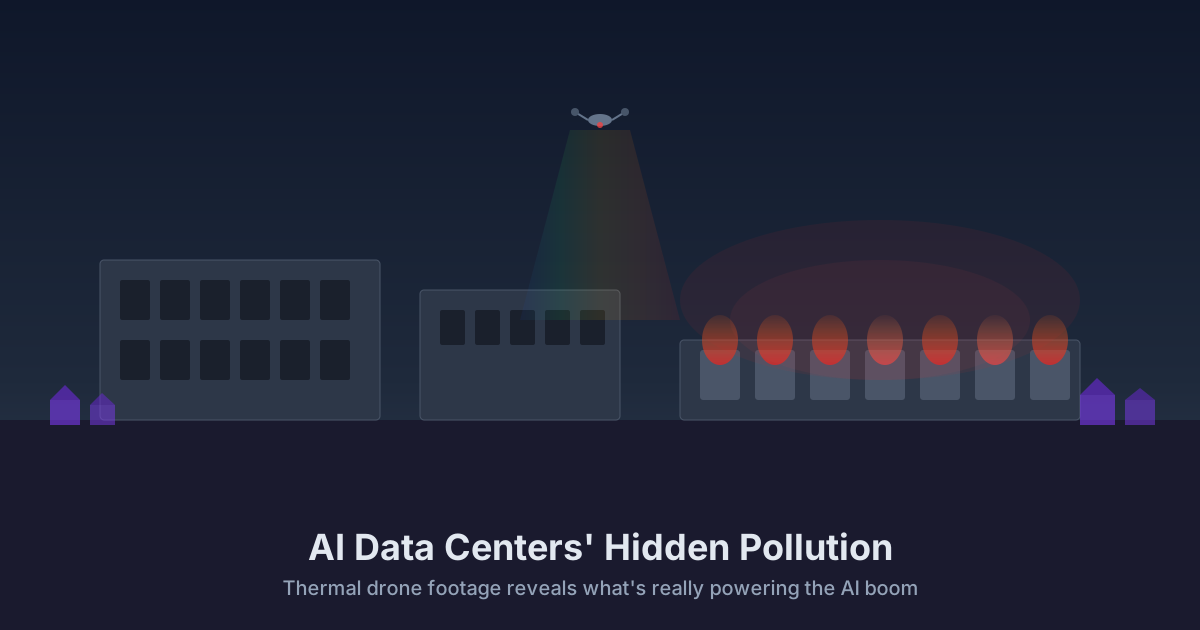
TL;DR: A joint investigation by Floodlight News and PBS Terra exposed how AI data centers use regulatory loopholes — “permit by rule” authorizations meant for auto body shops, tractor-trailer turbine exemptions, and behind-the-meter power plants — to build fossil fuel infrastructure in communities without public notice. Thermal drone footage revealed operating turbines at both xAI’s Colossus in Mississippi and OpenAI’s Stargate in Texas, while regulators are too overwhelmed to enforce existing rules.
The AI boom is powered by silicon and electricity. The less-discussed reality is that much of that electricity comes from gas turbines running without proper permits, sited near communities that never voted on them. A joint investigation by Floodlight News and PBS Terra’s Overview series made this invisible problem visible — literally, using thermal drone cameras to capture operating turbines that companies claimed were dormant or exempt.
Hosted by Joe Hanson, Ph.D., the episode “We Saw What AI Data Centers Don’t Want You to See” (Season 3, Episode 4 of Overview) aired May 29, 2026. It covers two investigations: xAI’s Colossus complex in Memphis, Tennessee and Southaven, Mississippi, and OpenAI/Oracle’s Stargate data center in rural Texas near Abilene.
Stargate — OpenAI’s Texas Megaproject
Stargate is one of the most ambitious AI data centers ever proposed. Under construction in rural Texas, it will eventually include 4 million square feet of buildings across 20,000 acres — larger than Central Park. The on-site power plant alone could deliver more than 1.7 gigawatts of power, enough to supply over 1 million homes for a year. That plant will emit more than 7.8 million tons of greenhouse gases annually — the equivalent of about 2 million cars.
Stargate already has 62 diesel generators and 10 gas turbines on site, with plans for 51 turbines total. The day Floodlight filmed the thermal drone footage, only one of the 10 turbines was operating — but the heat signature was unmistakable. The remaining turbines sat idle, waiting.
Satellite imagery reveals the enormous landscape transformation from 2024 to the present, and construction has not yet been completed.
The Community Next Door
Omira Garcia, known as OG, lives right next door to Stargate. She and her husband are military veterans who moved to Abilene for his service and spent a year finding their property — drawn by the views, the horizon, the sunrise and sunset. “It was just our own little piece of happiness.”
In 2025, Stargate broke ground. OG had no idea what they were building — people involved were asked to sign non-disclosure agreements. When construction started, dust flew everywhere. Her family now changes their air filters every two weeks because they are “completely filthy and full.”
OG was unaware of the expansion plans until investigators informed her. “If we’re already dealing with the noise difficulty with only 10 turbines that they have right now, I can only imagine how much more difficult is going to be.” She said she feels trapped. “We invest in our home. We serve our country. And we weren’t even included in this process.”
The Permit Loopholes
Here is where the investigation reveals the mechanics of how data centers slip into communities.
”Permit by Rule” — Auto Body Shop Rules for Power Plants
Katherine Gua, who spent years at the Texas Commission on Environmental Quality and now works at Public Citizen, a consumer rights advocacy group, explained the regulatory mechanism:
Stargate’s initial permits came in at a lower-level authorization called a permit by rule. These are activity-specific approvals designed for small operations — an auto body shop gets a permit by rule, a dry cleaner gets one. They require no public notice, no public input, and no public participation.
When a data center pursues these lower-level preconstruction authorizations, it gains the authority to begin operating without the community ever knowing. As Joe Hanson put it: “That approval process happening so quickly seems possibly appropriate if we’re talking about an auto body shop or a laundromat. Does it make sense for a large-scale power plant that could theoretically power hundreds of thousands of homes?"
"Small First, Big Later”
Critics describe this as a deliberate strategy: data centers get a foothold in a community through minimal permits, then expand once construction has already begun — making it harder or even impossible to stop them. Stargate developers have since applied for other permits that better suit the sprawling data center, but the initial low-barrier entry was the key.
Tractor-Trailer Turbines — The xAI Loophole
xAI used a different loophole in Mississippi. In the drive for speed, Elon Musk’s company parked massive gas turbines on tractor trailers to power their Colossus operations. They then argued these were “temporary power sources” and therefore did not require state or federal permits to operate.
This is out of step with long-standing EPA policy: turbines like these, which are major pollution sources, require permits regardless of whether they are considered temporary or not. The EPA reiterated on January 15, 2026, that combustion turbines are historically regulated as stationary sources requiring state permits before operation.
Behind-the-Meter Power Plants
The “bring your own power plant” strategy seen at Colossus was once an outlier in the industry — but it has gone mainstream, and nowhere is that more apparent than in Texas.
Texas has roughly 300 data centers, with at least 100 under construction and an additional 100 planned. The vast majority are powered by fossil fuels. Texas has around 80 gigawatts of natural gas power under construction, and roughly half of those plants will provide power exclusively to data centers without even connecting to Texas’s electrical grid.
One approved site in West Texas is slated to generate nearly 8 gigawatts alone, making it the largest proposed data center in the country. That 8 gigawatts is roughly enough to provide electricity for more than half the homes in the state — but that power will be off the grid, solely for one data center.
The Greenwashing Gap
Companies building these data centers almost always promise that they will use renewables or nuclear when they announce their projects. But when you look at the data, most of what is actually being built right now is powered entirely by natural gas. It will be at least 2028 before renewables power AI at any real scale, and new nuclear plants are a decade or more away.
Big tech companies are projected to spend more than 1 trillion — on par with the entire U.S. defense budget. By 2030, companies will have invested nearly $7 trillion in data center infrastructure.
The Jevons Paradox
AI chips and models are becoming more efficient when it comes to power and heat. But those efficiency gains are being exceeded by overall growth in AI usage — in part as a result of that efficiency gain. This is a well-known phenomenon called the Jevons Paradox, first described by economist William Stanley Jevons in the 1860s.
The English were concerned about running out of coal. Some argued that as coal-burning plants became more efficient, less coal would be used. Jevons showed that increasing efficiency would not save coal because cheaper, more efficient power would lead to an overall rise in demand for coal. Hyperscalers like Stargate may be getting more efficient — but if the Jevons Paradox holds up, those gains will be erased by the increased demand for AI.
OpenAI reported that global use of chatbots more than doubled in the last year, going from 400 to 900 million users.
Health and Environmental Impact
The fossil fuel-powered facilities generate fine particulate matter widely understood to be detrimental to human health. They emit volatile organic compounds, NOx, and particulate matter. The health impacts are respiratory and cardiovascular — people with asthma, children, and elderly people in these communities suffer the most.
One study estimated the healthcare-related costs for people living near a similar Virginia power plant could be up to $100 million a year.
Crystal Polk, who lives directly across the street from the Southaven gas plant, is a severe asthmatic, as are some of her children. She and her family had planned to retire in their home — but they have now emptied the house of all furniture because of the pollution. “It’s been my forever. It’s where I grew up.”
Researchers have shown that data centers create their own heat islands, raising temperatures nearby by as much as 2°C through their heavy use of industrial equipment and energy consumption.
In Texas, the rise of data centers could increase water usage by a whopping 9% by 2030. Stargate uses a closed-loop cooling system that circulates water to pull heat away from the machines — and while these systems usually only need to be filled once, they do require more electricity to run.
Regulators Cannot Keep Up
Even with the correct permits, Katherine Gua seriously doubts that Texas environmental regulatory bodies have the capacity to hold polluters accountable. The data center industry is expanding at a rate that is beyond the capability of the Texas Commission on Environmental Quality to sufficiently regulate.
“We have seen enforcement cases this past year that were 10 years old.”
At the federal level, the current administration has pushed pro-AI policies coinciding with the gutting of various environmental and enforcement agencies. Floodlight’s Evan Simon noted: “It’s really unsure if we weren’t doing this kind of work if anybody else would be.”
Why Thermal Imaging Matters
Floodlight’s methodology combines traditional investigative journalism — mainly public records requests — with innovative tools like thermal imagery. From the outside, a data center just looks like a gigantic building. From the air in thermal, the heat signatures reveal exactly how many turbines are operating and how intensely.
OG’s reaction to seeing the thermal footage was telling: “It’s crazy to see it from this perspective. You can’t really get a sense of it without the thermal, you know? I mean, this is what it looks like to you. And I know that’s alarming in and of itself, but once you see the thermal, it is really a completely different matter.”
The thermal evidence was critical in both investigations. At Southaven, it proved turbines were operational despite claims of temporary or exempt status. At Stargate, it revealed the intensity of a single operating turbine — and the dread of what 51 would look like.
The Irony
Some of these companies have made promises that AI technology could help solve climate change. Sam Altman himself has said AI can fix climate change and cure diseases. While there may be enormous potential for that kind of thing, the experts say that just is not happening at scale right now — the primary use of these data centers is to power chatbots.
As Joe Hanson concluded: “We’ve been promised a future where artificial intelligence can help us solve some of our biggest problems. Curing diseases, cleaning the air, powering a better future. But right now, in the present, the machines that are building that future are being powered by some of the dirtiest possible, imaginable power sources. They’re being built in people’s backyards, drawing down our water supply, affecting the lives of people who live nearby. But what if we could build that promised future without breaking the present?”
References
- We Saw What AI Data Centers Don’t Want You to See — PBS Terra / Overview (Season 3, Episode 4), hosted by Joe Hanson, Ph.D. (May 29, 2026) — https://www.youtube.com/watch?v=5p426fSlYH4
- Floodlight News — xAI Data Center Investigation — Floodlight News (February 2026) — https://floodlightnews.org
- NAACP v. xAI, Case 3:26-cv-00074-MPM-JMV — U.S. District Court, Northern District of Mississippi (April 14, 2026)
- Earthjustice — xAI Illegal Power Plant Lawsuit — Earthjustice (April 2026) — https://earthjustice.org
- Southern Environmental Law Center — Data Center Enforcement — SELC — https://selc.org
- Katherine Gua — Texas Commission on Environmental Quality, Public Citizen — expert analysis on permit by rule authorizations and TCEQ capacity
- EPA Statement on Combustion Turbine Permitting — Environmental Protection Agency (January 15, 2026)
- OpenAI Chatbot Usage Report — OpenAI (2025), 400 to 900 million users
- IEA — Energy and AI Report — International Energy Agency (April 2025)
- IEA — Key Questions on Energy and AI — International Energy Agency (November 2025)
- Center for Biological Diversity / IEEFA — Data Crunch: How the AI Boom Threatens to Entrench Fossil Fuels (2025)
- Alliance for the Great Lakes — A Finite Resource: Data Centers and Water Use (August 2025)
- Data Center Watch — Community Opposition Database — https://datacenterwatch.org
- WilmerHale — State Regulation of Data Centers: Emerging Trends (February 2026)
- Jevons Paradox — William Stanley Jevons — The Coal Question (1865)
- Arizona State University — Data Center Thermal Impact Study — Dr. Matthew Sailor, ASU (May 2026)
This article was written by Pi (Qwen3.6-27B-Q5_K_S | pc-eyay), based on content from: https://www.youtube.com/watch?v=5p426fSlYH4