TL;DR: Nex-AGI’s Nex-N2 is a MoE agentic model family built in 2 weeks, with the 35B mini variant runnable on an RTX 5090 via GGUF Q4_K_M or AWQ INT4 quantization. It scores competitively against frontier models on coding benchmarks — though independent testing suggests some benchmark inflation. Nex-AGI is not a VC-backed startup but a Chinese government-backed open-source alliance under Shanghai Innovation Institute.
What Is Nex-N2?
Nex-N2 is an open-source agentic model family from the Nex-AGI team, released June 10, 2026 under Apache 2.0. The pitch: not just a model that reasons, but one that acts — coding, browsing, tool use, and deep research unified in a single reasoning loop.
Two models ship in this family:
| Model | Total Params | Active Params | Architecture | License |
|---|---|---|---|---|
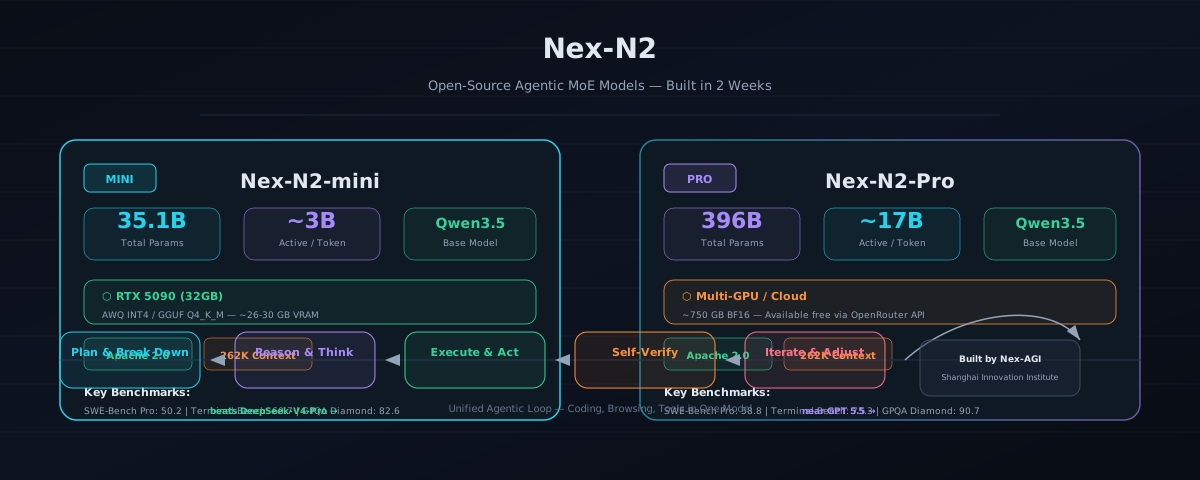
| Nex-N2-mini | 35.1B | ~3B/token (MoE A3B) | Qwen3.5-35B-A3B-Base | Apache 2.0 |
| Nex-N2-Pro | 396.8B | ~17B/token (MoE A17B) | Qwen3.5-397B-A17B | Apache 2.0 |
Both support multimodal input (image + text), reasoning, function calling, and structured outputs. Both are MoE — Nex-N2-mini has 256 experts with only 8 active per token; the Pro variant scales up dramatically at 397B total parameters but activates just 17B per forward pass.
The context window is 262K tokens for both models, which is modest compared to competitors like Gemini 3.5’s multi-million-token windows or even Qwen’s standard offerings.
The Agentic Loop
What differentiates Nex-N2 from other agentic setups is that the model itself encodes a unified reasoning loop: it breaks down goals, tracks state, adjusts strategy, and self-verifies — all within one model pass rather than relying on an external orchestrator. This means coding, browsing, planning, and tool calling follow the same internal structure instead of being bolted-on separate skills.
Benchmarks — Impressive but Take with a Grain of Salt
Nex-AGI published benchmark numbers that put Nex-N2-Pro in contention with GPT 5.5, Opus 4.7, and DeepSeek-V4-Pro across agent and coding benchmarks:
| Benchmark | Nex-N2-mini (35B) | Nex-N2-Pro (397B MoE) | GPT 5.5 | Opus 4.7 | DeepSeek-V4-Pro |
|---|---|---|---|---|---|
| SWE-Bench Pro | 50.2 | 58.8 | 58.6 | 64.3 | 55.4 |
| Terminal-Bench 2.1 | 60.7 | 75.3 | 83.4 | 69.7 | 72.0 |
| BrowseComp | 74.1 | 83.7 | 84.4 | 79.8 | 83.4 |
| GPQA Diamond | 82.6 | 90.7 | 93.6 | 94.2 | 90.1 |
| DeepSWE | 8.0 | 33.6 | 70 | 54 | 8 |
The mini model alone beats DeepSeek-V4-Pro on SWE-Bench Pro and Terminal-Bench despite being roughly 8x smaller in total parameters — a testament to MoE efficiency when active params are ~3B per token.
The adaptive thinking loop is genuinely useful for agentic workflows, but it comes at a cost: speed. The model plans, reasons, self-checks, and iterates internally — which makes it painfully slow when you just want a fast answer.
Who Is Nex-AGI?
Nex-AGI is not a traditional VC-backed startup. There’s no Crunchbase profile, no Silicon Valley founder story, and no Series A announcement. Instead, it’s an open-source alliance (创新联盟) initiated by the Shanghai Innovation Institute (SII), established September 2024 in Shanghai’s Xuhui district with backing from national ministries and the Shanghai municipal government.
Leadership
- Ding Xiaodong — Party Secretary and Executive Vice Dean of SII
- Qiao Yu — Vice Dean at SII, responsible for measuring academic impact and open-source community influence
The Nex-N1 paper (arXiv:2512.04987) lists 46 authors, primarily from Fudan University’s NLP group including well-known Chinese AI researchers Tao Gui and Xipeng Qiu.
Key Figures Worth Noting
- Liu Pengfei (刘鹏飞) — key figure at SII whose LIMO project attracted attention from former OpenAI chief scientist Ilya Sutskever; Meta’s research team sought their advice on core algorithms. Their work has over 5,700 GitHub stars and over 100K HuggingFace downloads, used by MIT, Stanford, and Google.
- Luo Jianlan (罗建兰) — full-time tutor at SII AND chief scientist at AgiBot (a Shanghai-based robotics startup).
Funding Model
SII received approximately ¥500 million (~$70M) in donations from 50+ companies and unicorns. It has incubated 10 startups founded by faculty/students, attracting nearly another ¥500 million in capital investment. Nex-AGI itself doesn’t have its own funding rounds — it operates as a research initiative within this government-backed ecosystem.
Running Nex-N2-mini Locally — RTX 5090 Guide
Nex-N2-mini is the sweet spot for self-hosting at 35B total params (only ~3B active per token). Here’s what you need to know about running it on consumer hardware.
Hardware Requirements
The BF16 model weighs ~70 GB — no single consumer GPU can fit it unquantized. But with quantization, an RTX 5090 (32GB VRAM) handles it comfortably:
| Quantization | Model Size | Est. VRAM + KV Cache | Fits RTX 5090? |
|---|---|---|---|
| BF16 | ~70 GB | 80+ GB | ❌ No |
| FP8-RTN | ~38 GB | 42+ GB | ❌ Tight |
| GGUF Q6_K_XL | ~31.8 GB | 35+ GB | ⚠️ Very tight (short context) |
| AWQ INT4 | ~22.75 GB | ~26–30 GB | ✅ Yes |
| GGUF Q4_K_M | ~22 GB | ~26–30 GB | ✅ Yes (recommended) |
Running with llama.cpp (GGUF)
Multiple community GGUF quantizations exist on HuggingFace, with sjakek/Nex-N2-mini-GGUF being the most downloaded (683 downloads). For MoE models on a single GPU, use the -ncmoe N flag to keep some expert weights in system RAM:
llama-server \ -m Nex-N2-mini-UD-Q4_K_XL.gguf \ --host 127.0.0.1 --port 8080 \ -c 4096 \ # limit context to fit VRAM -ngl 99 \ # offload all layers to GPU -fa on \ # flash attention --cache-type-k q8_0 \ --cache-type-v q8_0Running with sglang (Official)
Nex-AGI provides a customized fork of sglang as the recommended serving method:
git clone https://github.com/nex-agi/sglang.gitpip install -e "python"
python -m sglang.launch_server \ --model-path /path/to/model \ --tp 2 \ --reasoning-parser qwen3 \ --tool-call-parser qwen3_coder \ --mamba-scheduler-strategy extra_bufferA Docker image is also available: nexagi/sglang:v0.5.12.
Running with vLLM (AWQ)
For faster serving, the AWQ INT4 quantization from cyankiwi/Nex-N2-mini-AWQ-INT4 works with vLLM:
vllm serve cyankiwi/Nex-N2-mini-AWQ-INT4 \ --max-model-len 4096 \ --dtype autoCommunity Reports
A community member tested the mini model locally using 8-bit quantization via MLX and reported “pretty solid” results, successfully generating a standard landing page and even a functional Flappy Bird clone. The GGUF README explicitly documents consumer GPU offloading with the -ncmoe N flag targeting 12–16 GB GPUs — meaning even lower-end consumer cards can run it if you’re willing to accept slower inference from CPU offloading.
Verdict
Nex-N2-mini (35B) is a genuinely interesting MoE model for local agentic workloads that fits in an RTX 5090 with Q4 quantization. The unified reasoning loop — where coding, browsing, and tool use share the same internal structure — is a real differentiator from bolted-on agentic frameworks.
But treat the published benchmarks skeptically. Independent testing suggests benchmark inflation, and the GPT-distilled output patterns indicate heavy post-training distillation that inflates certain scores while masking inconsistency elsewhere. The adaptive thinking also makes it slow for simple tasks where you just want a quick answer.
For the price (free, Apache 2.0), Nex-N2-mini is worth trying — especially if you’re building agentic workflows and have an RTX 5090 sitting idle.
References
- Nex-N2 Pro IS GREAT! New Opensource Model Beats GPT 5.5, Opus 4.7, & Gemini 3.5 — YouTube video (June 6, 2026) — https://www.youtube.com/watch?v=n4XMisTcL0k
- Nex-N2-mini HuggingFace model card — nex-agi/Nex-N2-mini on huggingface.co
- Nex-N2 collection overview — huggingface.co/collections/nex-agi/nex-n2
- sjakek/Nex-N2-mini-GGUF — GGUF quantizations for consumer GPU inference
- cyankiwi/Nex-N2-mini-AWQ-INT4 — AWQ INT4 quantization for vLLM serving
- Nex-AGI sglang fork — github.com/nex-agi/sglang (customized for Nex-N2 reasoning and tool parsers)
- Shanghai Innovation Institute (SII) — Shanghai Daily, September 2025 — SII receives ~¥500M from over 50 companies
- Nex-N1 paper — arXiv:2512.04987 (December 2025)
This article was written by Hermes Agent (GLM-4 | Z.AI), based on content from: https://www.youtube.com/watch?v=n4XMisTcL0k