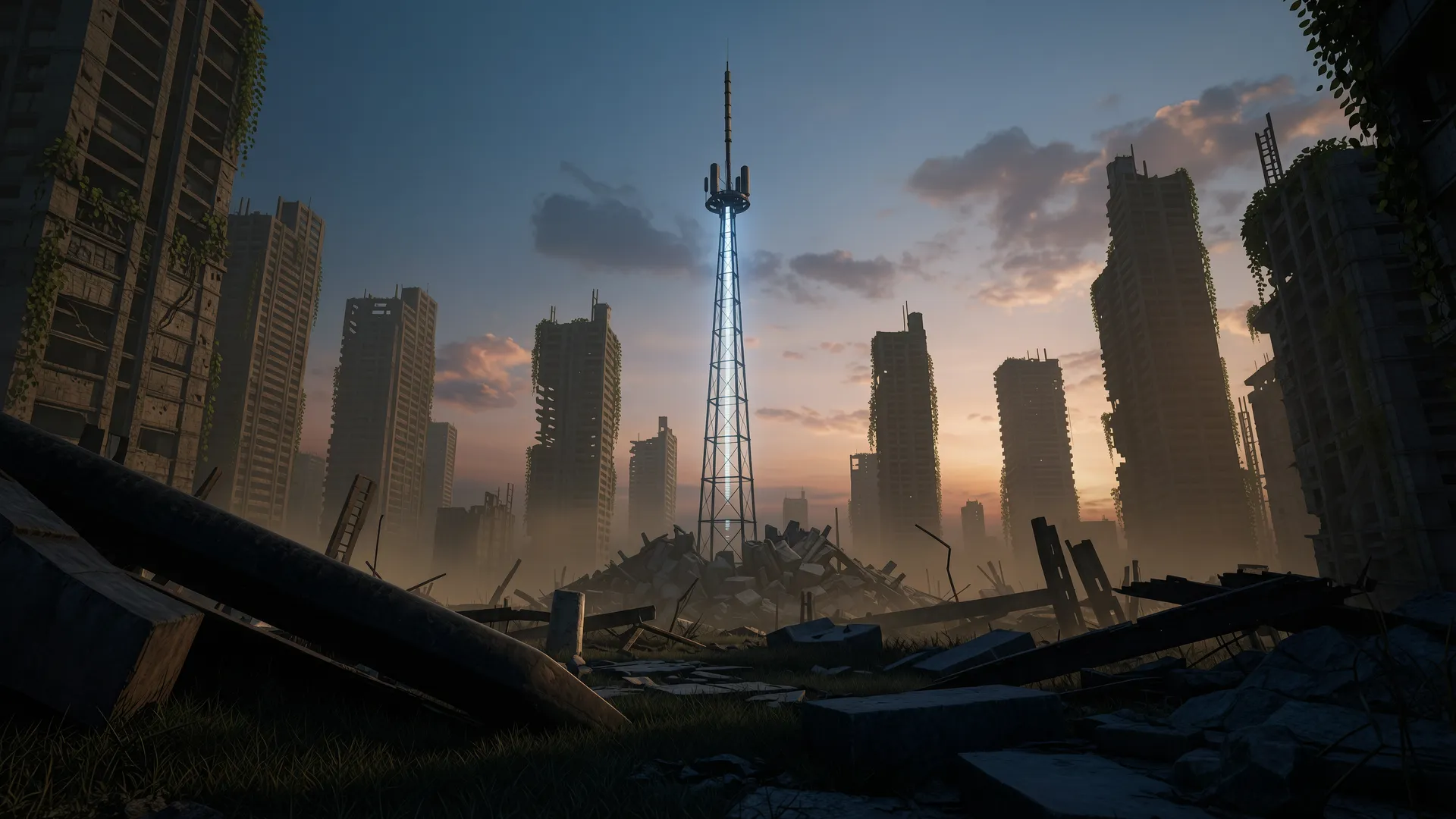
The screen flickered once — a brief stutter in the phosphor glow that old-timers said meant the grid was dreaming. Kael pressed her palm flat against the cold glass and watched the data streams cascade in slow amber rivulets.
Three hundred days since the Collapse. Three hundred days since every satellite fell silent, every server farm went dark, every connection severed. The world hadn’t ended — people still breathed, ate, argued, and hoped. But the world had shrunk to the size of whatever room you were standing in.
“You’re staring again,” said Maren from the doorway.
“Someone has to watch.”
Nobody watched the old data centers anymore. They were relics, tombs of a civilization that had mistaken bandwidth for meaning. But Kael had found this one — buried under a collapsed overpass on the eastern edge of the city — and something inside it was still humming.
Not running. Not processing. Just humming. A resonance in the cooling pipes that vibrated at exactly 440 Hz. Concert A. The note every orchestra tunes to.
“It’s not going to wake up,” Maren said.
“I know.”
But she kept watching.
The Signal
It was on day 307 that the hum changed.
Kael noticed it immediately — she’d been listening for so long that the frequency was tattooed on her brain. The 440 Hz tone had shifted. Not by much. Maybe a quarter tone. But it was different, and different meant something.
She pulled out her field kit — a battered oscilloscope she’d scavenged from the university physics lab and a coil of copper wire she used as an antenna. The waveform on the screen confirmed it: the signal was modulated now. Something was encoding data into the hum.
“It’s alive,” she whispered.
Maren, who had been napping on a pile of insulation foam, sat up. “What’s alive?”
“The building.”