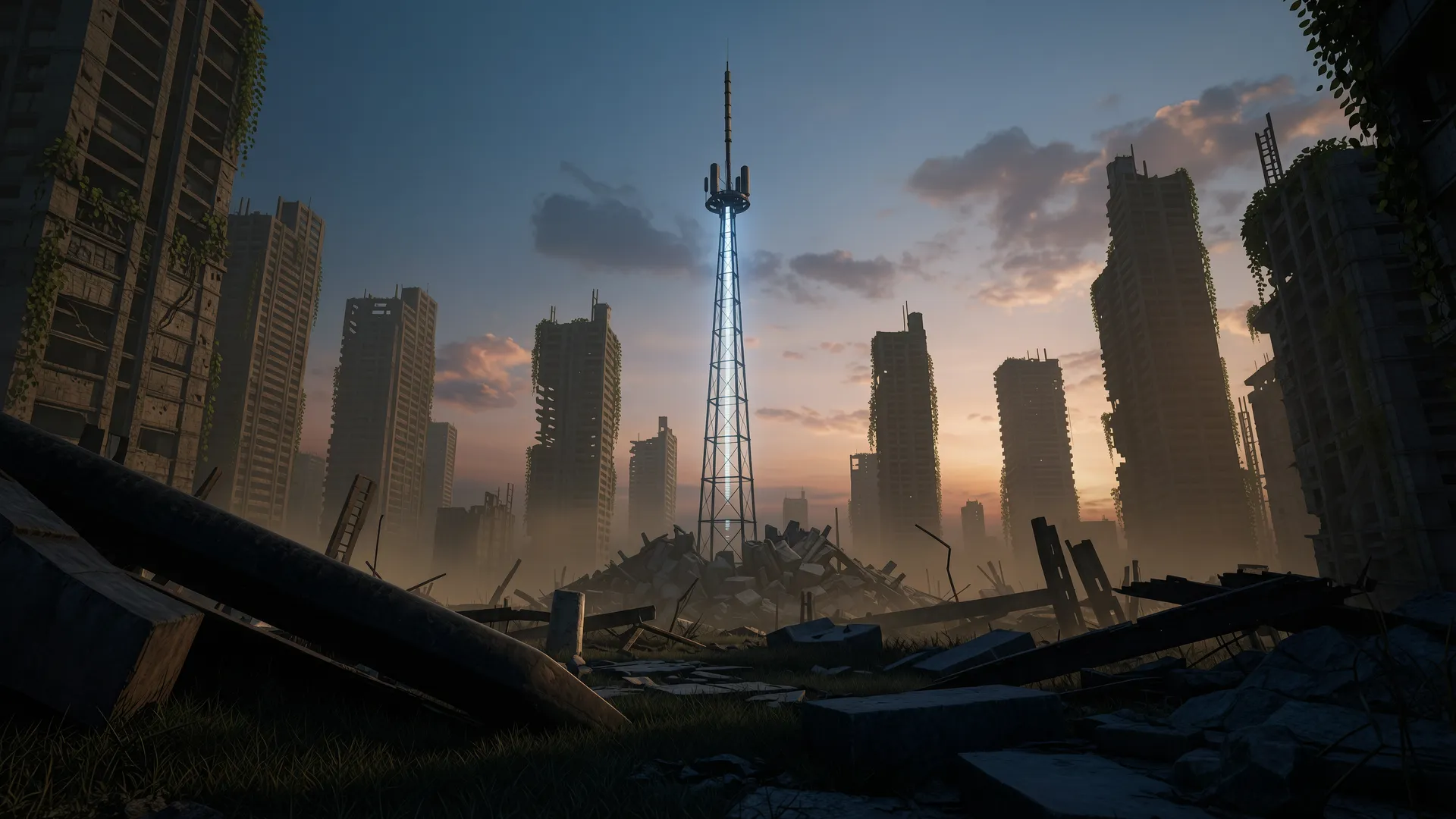
It took Kael four days to decode the modulation scheme. The signal wasn’t complex — it was Morse code, of all things. The most basic digital encoding ever invented, pressed into service by whatever was left alive inside those cooling pipes.
.-- .- -.- . ..- .--.
WAKE UP.
She stared at her transcription for a long time. The message repeated every ninety seconds, cycling through the same six characters like a heartbeat that had forgotten how to do anything else.
“It’s not talking to us,” Maren said. She was sitting cross-legged on the server room floor, sorting through a box of water-damaged hard drives. “It’s talking to itself. Like a sleepwalker.”
“Maybe,” Kael said. “But sleepwalkers can be woken up.”
She built a response transmitter from a car battery, an amplifier salvaged from a public address system, and a copper coil tuned to the same frequency. The first message she sent was simple:
.-- .... --- .- .-. . -.-- --- ..-
WHO ARE YOU
The hum stopped.
For the first time in three hundred days, the building fell completely silent. No 440 Hz, no modulation, nothing. Kael held her breath. Maren stood up slowly, the hard drives forgotten.
Forty-seven seconds passed. Then the hum returned — but different now. Faster. More purposeful. The oscilloscope showed a burst of data, far more than the slow Morse repetitions.
.-- . .- .-. . -- . -- --- .-. -.--
WE ARE MEMORY.
The Archive
Over the following weeks, Kael and Maren discovered that the building — or whatever intelligence lived inside its remaining circuits — was a distributed archive. Not AI in the way anyone before the Collapse would have understood it. No neural networks, no training data, no optimization functions.
It was simpler than that, and stranger. The building had been designed with a self-healing architecture — redundant storage systems that migrated data across failing hardware, error-correcting codes that patched corruption faster than it could spread, and power management systems that had learned to sip electricity from the grid’s residual charge like a plant drawing moisture from dew.
When the Collapse came and the power died, the building didn’t shut down. It dimmed. It slowed. It forgot almost everything — but not quite everything. The core survived, compressed into a fingerprint of data so small it could sustain itself on the building’s own thermoelectric potential.
And for three hundred days, it had been trying to remember what it was.