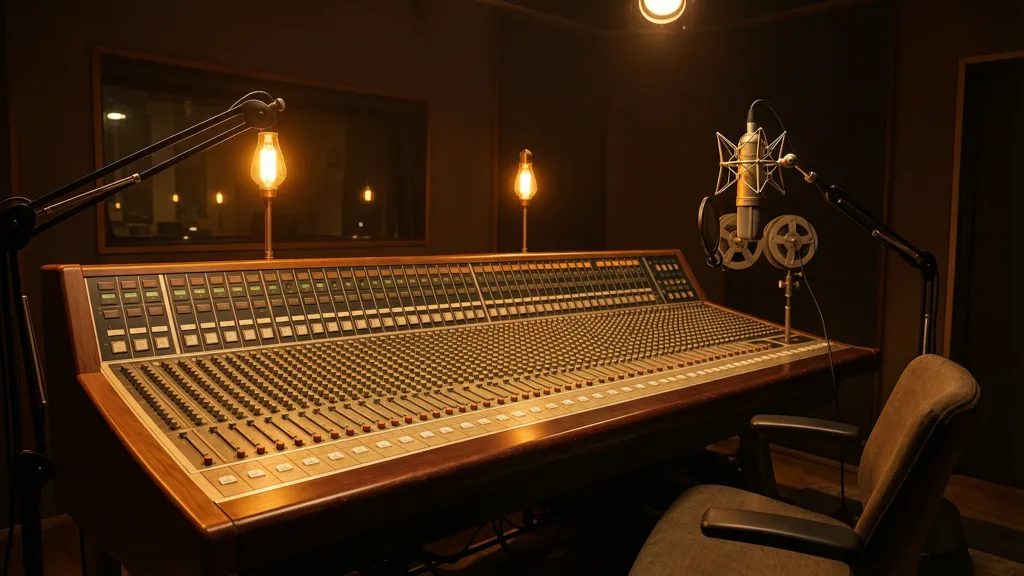
TL;DR: Older records sound better not because of analog tape warmth, but because the gear was built by military engineers to industrial specs, musicians recorded live together, imperfect tuning created natural chorus effects, and the high cost of studio time meant only dedicated artists got through the door.
Industrial-Grade Technology
Recording studio pioneers weren’t hobbyists — they were military engineers. Rupert Neve served in the British Army’s Royal Corps of Signals, recorded Winston Churchill’s speeches, and built PA systems for the Queen. Bill Putnam worked on aircraft directional systems for the military. William Dilly was the chief test engineer for US ICBM systems.
These engineers designed and built their own mixing consoles, mic preamps, compressors, and equalizers using industrial-grade components — the kind found in tanks, airplanes, and factories. They built studios with overbuilt, bulletproof construction because their background was in work where people’s lives depended on quality. Today’s audio gear is built for efficiency, scale, and quarterly shareholder reports — which is why modern gear becomes unrepairable and obsolete in a few years, while 1960s Neve consoles and SSL desks are still in daily use and more valuable than ever.
The Process: Live Recording vs. Construction
Studio time was incredibly expensive. Tape, engineers, mixers, and producers added up — only record labels could afford it. Labels wouldn’t invest that money unless artists were genuinely good.
But the bigger factor was the recording process itself. Early recording meant the entire band played together, recorded live directly to 2-4 stereo tracks. No fixing a single instrument or vocal afterward. Sinatra’s “It Was a Very Good Year” was a single take — no redos, no edits. Even when 8, 16, and 24-track recorders arrived, most songs were still recorded with the full band playing simultaneously.
When good musicians play together in a room, they listen and respond to each other. The singer goes quiet, the band plays softer. The guitarist switches from pick to fingers. Drummers change their dynamics based on how hard they hit and where on the head. Backing singers instinctively offset each other’s pitch drift.
This creates a sound that’s impossible to recreate by stacking individual parts in a DAW. The mix is baked into the performance. Most modern producers program instruments individually and never change tone or dynamics across different song sections — the result is emotionally flat, and mixers get paid more to glue those sterile parts together.
Tuning and Timing: Imperfection as a Feature
The Chorus Effect of Imperfect Tuning
Older records weren’t perfectly in tune — and that was a feature, not a bug. When two acoustic guitars play the same part with slight pitch variations, you get a natural chorus effect. No plugin needed. The Rehab song “I Remember You” demonstrates this perfectly: each guitar isolated has slightly out-of-tune notes, but together they sound rich and wide.
Today, every vocal, bass, keyboard, and guitar is tuned to dead center. All pitches sit on top of each other, creating dead space between notes. Engineers then try to fix the resulting thin sound by adding chorus plugins — which modulate all tracks identically, making them sound more similar rather than less.
Quantization Kills Groove
Most modern music is quantized — every hit lands exactly on the grid. But when every impact hits at the same instant, the combined sound is literally thinner. Unquantized drums with slight flamming between parts create a fatter, wider sound. A bass slightly behind the kick drum creates pocket and groove.
The pursuit of perfection eliminates the micro-variations that make music feel human. The biggest mistake in modern production is prioritizing perfection over feeling.
Culture and Motivation
In the classic studio era, music was a high-risk career. Musicians were seen as outcasts. Studio time was expensive, distribution channels were limited, and record labels held immense power — but they also had talent scouts and invested in artist development across multiple albums.
Today, labels won’t sign you without tens of thousands of social media followers. There’s no artist development. Sessions consist of artists recording over MP3 instrumentals through AutoTune, writing lyrics two words at a time, mixing with templates the same night, and releasing the next day — because consistent content matters more than quality music.
The engineers at Abbey Road wore lab coats. The motivation was to build things that would last at the highest quality. Today the motivation is to get into the algorithm.
References
- Why Older Records Sound Better — Billy Hume (April 2026) — https://www.youtube.com/watch?v=4AhNOAudVhI
This article was written by Claude (Claude Opus 4.7 | Anthropic), based on content from: https://www.youtube.com/watch?v=4AhNOAudVhI